Why Business Strategy Certifications Are Essential for Leadership Development
 February 17, 2026
You can be the smartest person in the room, with a resume full of accomplishments, and still feel unprepared for what’s coming next. The rules have changed. A competitor launches an AI-powered product that redefines your entire category. A regulatory shift in one country creates ripple effects across your global operations.
Business strategy programs address complex leadership challenges by combining theory with real-world application. According to Gartner research, companies that prioritize leadership development see higher employee engagement, improved business performance, and greater innovation. These structured learning experiences provide professionals with frameworks, methodologies, and insights that are difficult to acquire through informal learning alone.
Strategy certification has evolved beyond simple skill verification. Certified professionals signal their commitment to continuous growth, their readiness for complex challenges, and their capacity to translate technical knowledge into organizational value. This shift reflects a broader transformation in how organizations identify and develop their future leaders.
What is a Business Strategy Certification?
A business strategy certification is a professional credential that equips individuals with essential skills in strategic planning, analysis, execution, and leadership to align organizational goals with market realities and drive long-term success.
Why Business Strategy Programs Matter for Leadership Development?
Business strategy programs bridge the gap: giving leaders the tools to see the bigger picture, make bold decisions, and align teams around long-term success.
Here’s why investing in strategic thinking differentiates effective leaders from exceptional ones.
1. Bridging Technical Mastery and Strategic Vision
Many talented professionals excel in their functional domains yet struggle to transition into leadership roles. The gap between operational execution and strategic thinking often proves difficult to cross without structured guidance. Business strategy programs address this challenge by teaching participants to view organizations holistically rather than through narrow functional lenses.
Consider a marketing director who understands campaign metrics but lacks exposure to financial planning, supply chain dynamics, or organizational behavior. Strategy certification provides this broader perspective, enabling them to connect departmental initiatives with enterprise objectives. They learn to evaluate trade-offs, allocate resources strategically, and anticipate how decisions in one area ripple through the entire organization.
Certification programs teach participants to analyze internal and external environments, identify business opportunities, and design proactive responses to threats. This shift from reactive problem-solving to strategic planning distinguishes managers from leaders. Professionals gain frameworks like SWOT analysis, Porter’s Five Forces, and scenario planning that support informed decision-making under uncertainty.
2. Validating Leadership Readiness Through External Recognition
Organizations rely on objective indicators when evaluating candidates for leadership positions. While internal performance reviews provide valuable insights, they reflect specific contexts that may not transfer across roles or companies. Strategy certification offers external validation of a professional’s capabilities, demonstrating mastery of concepts that apply universally across industries and markets.
Programs from well-known institutions carry significant brand value. These credentials communicate that a professional has engaged with rigorous curriculum, learned from world-class faculty, and met high standards for completion. Employers recognize these qualifications as proof of both competence and ambition.
Certifications also demonstrate dedication and persistence. Earning credentials requires substantial investment of time and effort, qualities that employers value in potential leaders. The discipline needed to complete demanding coursework while managing professional responsibilities signals the resilience required for executive roles.
Core Competencies Developed Through Strategy Certification
Strategy certification programs go far beyond theory. They build practical, high-impact skills that today’s leaders need to navigate complexity and drive results.
Here’s a clear look at the core skills you’ll gain, and why they’re essential for standing out.
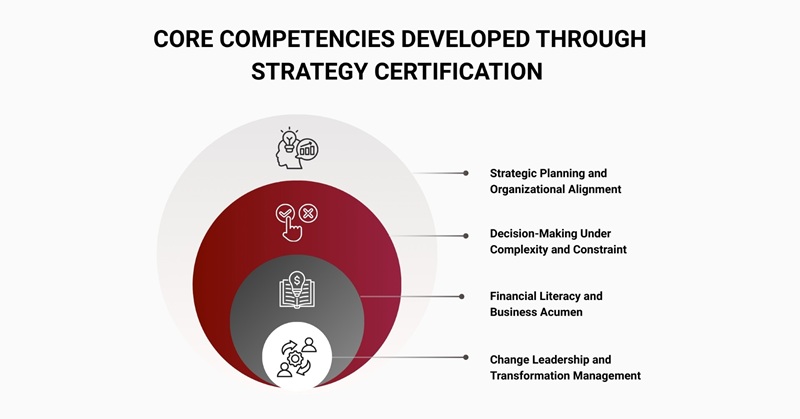
1. Strategic Planning and Organizational Alignment
Business strategy programs emphasize the creation and execution of long-term plans that position organizations for sustainable success. Participants learn to define clear objectives, identify critical initiatives, and build roadmaps that guide resource allocation and priority setting.
Strategic planning extends beyond documentation. Leaders must translate vision into action by aligning teams, processes, and systems around shared goals. Certification programs teach how to cascade strategy throughout organizational hierarchies, ensuring that frontline activities support broader objectives. Professionals develop skills in:
- Setting measurable key performance indicators that track strategic progress
- Building balanced scorecards that monitor multiple dimensions of performance
- Creating accountability frameworks that link individual contributions to organizational outcomes
- Adjusting strategies based on market feedback and dynamics
The ability to plan strategically and execute effectively distinguishes high-performing leaders. These capabilities enable professionals to anticipate changes in their industry, allocate resources efficiently, and maintain organizational focus through periods of disruption.
2. Decision-Making Under Complexity and Constraint
Leadership involves constant decision-making amid incomplete information, competing priorities, and high stakes. Business strategy programs develop structured approaches that reduce guesswork and cognitive bias while improving outcomes.
Participants learn decision frameworks including cost-benefit analysis, decision trees, risk matrices, and Monte Carlo simulations. These tools help leaders evaluate options systematically, weigh probabilities, and select courses of action that optimize long-term value. Case studies from real organizations provide practice in applying these methods to complex scenarios.
Strategy certification also addresses the behavioral dimensions of decision-making. Leaders learn to recognize common psychological traps such as confirmation bias, anchoring, and groupthink. They develop techniques for seeking diverse perspectives, challenging assumptions, and maintaining objectivity when stakes are high.
3. Financial Literacy and Business Acumen
Regardless of functional background, modern leaders must understand the financial implications of their decisions. Business strategy programs equip professionals with foundational knowledge in accounting, finance, and economics that enables meaningful participation in executive discussions.
Participants learn to interpret financial statements, analyze profitability drivers, and evaluate investment opportunities. They gain familiarity with concepts like return on investment, net present value, and working capital management. This financial fluency allows leaders to justify initiatives with data, monitor departmental performance, and adjust strategies based on economic realities.
Programs include modules on value creation, cost control, and performance metrics. Leaders learn to leverage business intelligence tools, interpret dashboards, and make decisions grounded in financial analysis rather than intuition alone.
4. Change Leadership and Transformation Management
Organizations must continuously evolve to remain competitive. Whether adopting new technologies, entering new markets, or restructuring operations, change initiatives require skilled leadership to succeed. Research shows many transformation efforts fail due to poor leadership and lack of employee buy-in.
Business strategy programs teach methodologies for managing change effectively. Participants study frameworks like Kotter’s 8-Step Process, ADKAR (Awareness, Desire, Knowledge, Ability, and Reinforcement), and the McKinsey 7S Model. These approaches help leaders plan transitions, communicate effectively, address resistance, and sustain momentum through implementation.
Certified professionals gain expertise in building coalitions, identifying early adopters, and creating positive pressure for change. They learn to balance empathy with accountability, recognizing that successful transformation requires both emotional intelligence and execution discipline.
Ready to Think and Lead Strategically?
Explore ABSP™ and SBSP™ certifications designed for professionals moving into strategic leadership roles.
Apply Now
How to Get the Most from Your Strategy Certification?
A strategy certification is a powerful investment, but its real payoff comes when you put what you’ve learned into action right away and build lasting connections. These steps turn new knowledge into visible results, faster promotions, and a stronger professional network.
1. Applying Learning Immediately
The true value of business strategy programs emerges through application. Professionals should seek opportunities to implement new concepts, frameworks, and techniques within their current roles. This practice reinforces learning while demonstrating capability to employers.
Consider proposing an initiative that addresses organizational challenges using methodology learned through certification. Lead cross-functional project applying new planning frameworks. Share insights with teams to build credibility as a strategic thinker.
Immediate application accelerates career advancement for leaders by making certification benefits visible to decision-makers. Managers who observe professionals applying thinking to real challenges develop confidence in their readiness for expanded responsibilities.
2. Leveraging Professional Networks
Business strategy programs provide access to valuable networks of accomplished peers and alumni. These connections offer ongoing learning, career advice, mentorship, and potential job referrals. Competitive industries often favor candidates with strong professional networks.
Engage actively with fellow participants during certification programs. These relationships often evolve into valuable collaborations and career connections. Many programs grant access to exclusive alumni communities where professionals share opportunities and insights.
Network engagement positions professionals as thought leaders within their fields. Speaking at conferences, contributing to publications, or taking advisory roles further accelerate career advancement for leaders by building reputation and visibility.
The Real Career Boost from Business Strategy Programs
Here’s how certification delivers real, measurable career boosts.
Accelerating Promotion Timelines
Strategy certification directly influences career trajectories by positioning professionals as ready for expanded responsibilities. Organizations increasingly factor professional development credentials into promotion decisions, viewing them as objective evidence of leadership potential.
A mid-level manager pursuing certification in leadership gains advantage when applying for director positions. The credential demonstrates understanding of how to align team objectives with company strategy, make informed decisions, and manage cross-functional challenges. Promotions reward demonstrated potential rather than just past performance, and business strategy programs provide tangible proof of readiness.
Companies prefer certified leaders for executive roles because credentials signal commitment to continuous learning. In volatile markets where adaptation determines survival, this growth mindset becomes particularly valuable. Leaders pursuing certification demonstrate a proactive commitment to personal and professional growth.
Increasing Compensation Through Enhanced Value
Data from LinkedIn Learning reveals that professionals with leadership certifications earn up to 20% more than non-certified counterparts. This premium reflects the enhanced value certified leaders deliver to organizations through improved decision-making, team performance, and execution.
Compensation increases occur through multiple mechanisms. Certified professionals are selected for high-visibility projects with larger scopes and budgets. These assignments come with better pay and create opportunities for further advancement. Success on initiatives builds reputation and influence within organizations.
The earnings gap compounds over time as certified leaders progress faster through organizational hierarchies. Early investment in business strategy programs yields returns throughout entire careers, making certification highly cost-effective for ambitious professionals.
Opening Pathways to Executive Leadership
Business strategy programs serve as gateways to C-suite positions. Executive roles require deep understanding of organizational dynamics, planning, and financial oversight, competencies central to most certification curricula.
Professionals with credentials from respected institutions are frequently shortlisted for positions such as Chief Strategy Officer, Director of Operations, or Vice President of Innovation. These certifications carry global recognition, adding weight to resumes when pursuing international or multi-regional leadership opportunities.
Consider the case of Sarah Chen, a senior product manager at a technology firm who completed an executive education program in strategic leadership. Within 18 months of certification, she was promoted to Vice President of Product Strategy, a role that had previously been filled exclusively by candidates with MBA degrees or C-suite experience. Her certification demonstrated the strategic thinking capabilities required for the position, effectively bridging the credibility gap and accelerating her trajectory by an estimated three to four years.
Global recognition proves especially important as business becomes increasingly interconnected. Employers seek leaders who can manage diverse teams, navigate cross-cultural challenges, and scale operations across geographies. Strategy certification demonstrates both technical competence and readiness to lead in complex environments.
How to Choose the Best Business Strategy Program for Your Career?
With hundreds of strategy certifications and executive programs available, choosing the one that truly advances your career can feel overwhelming. The key is finding a program that matches your current stage, specific goals, and the level of credibility you need in your industry.
Let’s break it down into two simple steps:
1. Aligning Credentials with Career Objectives
The abundance of available certifications can overwhelm professionals seeking leadership development. Selecting appropriate programs requires clarity about career goals, current experience level, and industry requirements.
Early-career professionals benefit from foundational programs that develop core leadership and strategy skills. These certifications build competence in planning, decision-making, and team management. Mid-level managers might pursue specialized credentials in innovation, transformation, or global strategy that address specific organizational challenges.
Senior leaders should seek executive programs providing advanced insights and global perspectives. These intensive experiences, often delivered by institutions like TSI, prepare participants for C-suite responsibilities through immersive learning with accomplished peers.
2. Evaluating Program Quality and Recognition
Course content matters, but institutional credibility plays equally important roles. Certifications from universities with strong reputations, carry more weight in hiring decisions and promotions. Look for programs accredited by organizations, which signal rigorous academic standards. Faculty expertise adds significant value. Programs led by experienced business leaders, researchers, and practitioners offer richer learning experiences. Consider whether instructors bring both academic credentials and practical industry knowledge.
Global recognition becomes important for professionals pursuing international opportunities. Programs from TSI and similar institutions provide credentials respected worldwide, opening doors across geographies and sectors.
Conclusion
Business strategy programs serve as foundational pillars in shaping tomorrow’s leaders. They provide structured pathways for acquiring capabilities that organizations desperately need:
- Strategic thinking
- Decision-making under uncertainty
- Change management
- Financial acumen
Strategy certification validates these competencies while signaling commitment to growth.
The role of credentials extends beyond skill development. They open doors to executive opportunities, accelerate promotion timelines, and increase earning potential throughout careers. Professionals who invest strategically in their development position themselves as indispensable assets capable of driving organizational success.
Selecting appropriate business strategy programs requires reflection on career objectives, industry demands, and personal development needs. Whether pursuing foundational leadership training or executive credentials, the right certification equips professionals with strategic insight, execution discipline, and influence needed to lead effectively.
Leadership development represents a lifelong journey requiring continuous investment. Strategy certification formalizes commitment to becoming a more strategic and impactful leader. Decisions made today about professional development shape not just individual futures but the futures of teams, organizations, and entire industries.
Frequently Asked Question
Q. What is the value of a business strategy certification?
A. Business strategy certification provides frameworks for complex decision-making, demonstrates commitment to professional growth, and positions of professionals for leadership opportunities. It delivers tangible career advantages including faster promotions, higher compensation, and enhanced credibility when pursuing executive roles.
Q. Are business strategy certifications worth it for leadership roles?
A. Yes, strategy certifications significantly benefit leadership careers. Organizations increasingly factor professional development credentials into promotion decisions, viewing them as objective evidence of leadership readiness. Certified professionals are more frequently shortlisted for C-suite positions and executive opportunities.
Q. Which professionals benefit most from strategy programs?
A. Mid-level managers seeking director or VP positions, technical specialists transitioning to leadership roles, and experienced professionals pursuing C-suite positions benefit most. Strategy programs are particularly valuable for those looking to move beyond domain expertise into cross-functional leadership responsibilities.
Q. Do strategy certifications increase salary?
A. Data from LinkedIn Learning reveals that professionals with leadership certifications earn up to 20% more than non-certified counterparts. The compensation premium reflects enhanced value through improved decision-making, increased selection for high-visibility projects, and faster progression through organizational hierarchies.
Q. How do employers view strategy credentials?
A. Employers view strategy credentials from respected institutions as signals of leadership potential, commitment to continuous learning, and readiness for complex challenges. Certifications from known institutions carry particular weight, especially for international and multi-regional leadership positions.