Skills That Will Define Successful Leaders by 2030
 February 20, 2026
The global business environment demands a transformation in how we approach strategic leadership. CEOs face an unprecedented volume of challenges every hour: geopolitical instability, rapidly advancing artificial intelligence, climate change impacts, and shifting workforce expectations. According to McKinsey research, leading has become more difficult than ever before, requiring decisions to be made quickly and accurately despite knowledge gaps and intense stakeholder scrutiny.
Research conducted by CEMS involving 20 global companies reveals a striking consensus. While technical expertise and strong business fundamentals remain vital, they no longer suffice. Tomorrow’s business leaders must combine analytical strength with creativity, cultural intelligence, entrepreneurial spirit, and a human-centered approach to decision-making that enables meaningful impact.
The most successful organizations recognize this shift. They understand that traditional executive education and talent programs must accelerate the development of next-generation competencies. Strategic leadership now requires bridging the gap between innovation and humanity, demanding both sharp analytical minds and the courage to lead responsibly.
How Leadership Must Evolve in an Al-Driven and Human-Centered World?
Here are the five essential competencies every leader must master to thrive, and why they’re becoming non-negotiable by 2030.
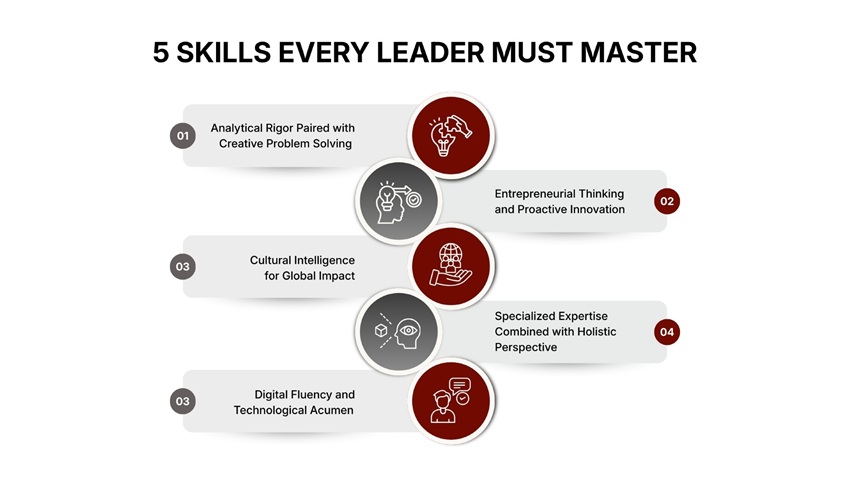
1. Analytical Rigor Paired with Creative Problem Solving
The ability to analyze large volumes of data remains indispensable for business leaders. However, corporate partners emphasize that technical prowess alone provides no differentiation. What distinguishes exceptional leaders is their capacity to creatively apply analytical insights.
One corporate executive explains this distinction: "Let’s say you have the best horsepower ever. You’re a super professional, you’ve got great practical skills, and you have great vision. That’s fantastic, but where you differentiate is how you use all that." Success depends on understanding data implications, facilitating organizational change, driving measurable impact, and influencing diverse stakeholders.
Strategic leadership requires synthesizing complexity into clarity. Business leaders must balance structured thinking with innovative approaches to problem-solving. Automation and AI can handle routine analysis, but human creativity transforms raw insights into transformative decisions. The London School of Economics addresses this need through its Marketing Analytics course, where students explore techniques like A/B testing and sentiment analysis while applying insights to inform choices under uncertain conditions.
2. Entrepreneurial Thinking and Proactive Innovation
The business environment evolves too rapidly for reactive approaches. Organizations need leaders who embrace ambiguity, question established norms, and create new pathways forward. This entrepreneurial mindset combines agility, resourcefulness, and the confidence to act without a predetermined roadmap.
BNP Paribas values graduates who demonstrate flexibility in both tasks and problem-solving approaches. Nicolas Barbier, Head of Company Engagement at BNP Paribas Portugal, notes: "We look for graduates who can ’connect the dots’ and thrive in cross-functional teams. Success comes from co-creation, adaptability, and the ability to apply data and technology within diverse, dynamic settings."
Entrepreneurial leadership means pursuing innovation with purpose. Business leaders must champion change initiatives, allocate resources to experimental ventures, and maintain momentum through setbacks. The University of Cape Town’s Business Development and Doing Business in Africa seminar exemplifies this approach. Students engage directly with local entrepreneurs in historically excluded communities, learning to navigate uncertainty while understanding how political and economic forces shape opportunities.
3. Cultural Intelligence for Global Impact
Research findings highlight cultural intelligence as foundational to effective leadership. This competency encompasses the ability to work effectively with diverse teams, understand different perspectives, and build inclusive environments where innovation flourishes.
Cultural intelligence cannot be acquired through textbooks alone. It requires immersive experiences and guided reflection. The Vienna University of Economics and Business addresses this through its Global Leadership course, where students spend time in microcultures including the Roma community, Europe’s largest ethnic minority. These experiences encourage leaders to examine their assumptions, develop genuine empathy, and practice perspective-taking.
As global fragmentation and polarization intensify, business leaders must build consensus among disparate groups. They need to navigate cultural differences, establish relationships across borders, and influence international teams effectively. Hands-on experience working with diverse colleagues becomes critical for developing the bridging skills necessary for global collaboration.
The American University in Cairo combines theory with practice through its Tribal Leadership Project. Students visit Dandara, a village in Upper Egypt, meeting local leaders to understand their approaches to sustainability, education, and community development. Such experiences prepare business leaders to appreciate varied contexts and adapt their strategic approaches accordingly.
4. Specialized Expertise Combined with Holistic Perspective
Corporate partners emphasize that broad management knowledge no longer provides sufficient preparation. Strategic leadership requires both deep, specialized knowledge in specific domains and integrative vision that connects expertise to strategy, ethics, and societal context.
One interviewee captures this duality: "Students need to learn hard skills and acquire practical experience." Business leaders must bring sector-specific mastery while maintaining a holistic understanding of organizational operations. Those who can integrate technical depth with breadth will excel in complex, interdisciplinary environments.
The University of St. Gallen demonstrates this approach through a module placing humanitarian principles in corporate contexts. Students examine how global issues like climate change and migration intersect with business operations, developing the capacity to view challenges through multiple lenses simultaneously.
Korea University Business School takes a similar approach with an elective on the global game industry. The course examines strategy, distribution, and ethics, helping students develop sector-specific knowledge while viewing it through a broad management framework. This dual focus enables leaders to make informed decisions that balance technical considerations with broader organizational implications.
5. Digital Fluency and Technological Acumen
While business leaders need not become data scientists or coders, understanding digital trends, data analysis, and emerging technologies has become non-negotiable. One corporate partner observes: "Each and every company from any sector will have its own microsoftware house in its core in the next decade."
Strategic leadership demands the ability to bridge gaps between technical teams and business units. Business leaders must critically assess data, translate insights across organizational boundaries, and drive informed decisions that create value. Digital fluency enables leaders to understand the implications and intricacies of artificial intelligence, automation, and other emerging technologies.
Cornell SC Johnson College of Business offers an elective in Python programming for data analysis, ensuring students can manipulate large datasets and grasp algorithm design basics. The London School of Economics goes further with its Managing Artificial Intelligence course, challenging students to consider profound questions about maintaining humanity while managing AI systems. These programs prepare business leaders to use digital tools responsibly while navigating technology-driven business environments.
Human-Centered Leadership Skills for Strategic Success
Beyond technical and analytical competencies, research emphasizes the growing importance of deeply human skills that cannot be automated. These capabilities connect business leaders to their teams and broader societal responsibilities.
Resilience and Adaptability in Volatile Environments
Strategic leadership requires navigating a volatile, uncertain, complex, and ambiguous world. Business leaders must guide organizations through crises and transformations while maintaining composure and clarity. The highest-performing leaders approach periods of disruption with calm, confidence, and focus on future needs alongside current emergencies.
General Jim Mattis explains in his book Call Sign Chaos: "Instillation of personal initiative, aggressiveness, and risk-taking doesn’t spring forward spontaneously. It must be cultivated for years and inculcated, even rewarded, in an organization’s culture."
The US Navy SEALs and other military institutions conduct "hot wash" reviews, after-action meetings held immediately following emergencies or drills. Leaders take stock, celebrate noble failures, and extract lessons for future missions. Similar practices are becoming common in hospitals, software development, and other sectors. Procter & Gamble launched its Fastest Learner Wins platform, featuring short, accessible interviews with experts that employees can access anytime, anywhere.
Emotional Intelligence and Authentic Connection
Guy Lubitsh, Professor of Leadership and Psychology at Hult International Business School, observes a widening communication gap between leaders and their teams. He notes that employees want their realities acknowledged, from financial stress and work-life pressures to mental health challenges. This shift demands business leaders who foster genuine emotional connection.
Modern leadership means mastering what Lubitsh calls "the duality of presence and space: the ability to connect deeply and direct purposefully, while stepping back to allow reflection, renewal and empowerment of others." Holding this tension between guiding and giving room has become critical for navigating contemporary workplace complexities.
Lufthansa Group grounds its leadership approach in three principles:
- Ambition: Agility and readiness to create organizational impact
- Responsibility: Fostering empowerment through embedded feedback and appreciation
- Empathy: Enabling collaboration by inspiring others and bringing together diverse perspectives
Jonathan von Gutzeit, Senior Director of Talent Attraction and Employee Experience at Lufthansa, explains: "These traits guide how we develop leaders from the ground up."
Western University’s Ivey Business School addresses this need through a session on Mindfulness, Self-Compassion, and Leadership in a World of Uncertainty. Students learn research-based techniques to develop inner resources for managing volatility, regulate themselves, sustain resilience, and lead with compassion under pressure.
Values-Driven Strategic Decision Making
Organizations increasingly expect business leaders to align success with a broader societal impact. Strategic leadership must prioritize ethical decision-making and corporate responsibility alongside financial performance. This values-driven approach recognizes that long-term organizational health depends on contributing meaningfully to society.
One corporate partner emphasizes that "self-awareness and self-reflection" will be crucial success factors. Business leaders must understand their own values, biases, and motivations. This self-knowledge enables more conscious decision-making and builds trust with stakeholders who increasingly scrutinize corporate behavior.
Customer-oriented cultures at companies like Amazon demonstrate the power of values-driven leadership. CEO Andy Jassy explains: "A lot of the invention we do is listening to something customers are really struggling with, and they won’t tell you how to do it, but we start asking ourselves why those constraints have to happen and start to invent on their behalf."
Building Change Management Skills Through Leadership Development
Strategic leaders must excel at change management skills, guiding organizations through continuous transformation. McKinsey research emphasizes that very few organizations devote sufficient time and resources toward developing the next generation of business leaders. CEOs at top-performing companies are setting themselves apart by establishing leadership factories to develop tomorrow’s strategic leaders today.
The most important lesson from this research? The CEO must be involved, deeply and personally, in the leadership development process. This hands-on approach ensures that strategy leadership skills are cultivated systematically rather than left to chance.
Effective change management skills development includes:
- Skip-level meetings, where senior leaders connect directly with high-potential employees across all levels
- Field promotions that place individuals in high-pressure leadership roles based on their potential
- "Fail fast, learn faster" cultures that encourage innovation and growth
- Targeted interventions addressing specific challenges in pivotal organizational roles
NVIDIA’s Jensen Huang exemplifies this inclusive approach: "At the meetings I have, there are new college grads there. There are people from every different organization." This democratization of strategic dialogue accelerates leadership development and surfaces innovative ideas from throughout the organization.
Preparing for Strategic Leadership in an AI-Driven World
As McKinsey notes, as we rethink the future of work in a world of traditional methods, generative AI, and agentic AI, the one role that won’t be disintermediated is that of the leader. However, leadership must evolve to remain relevant.
Business leaders face decisions about how to optimize processes that AI can now automate. Competitors are already leveraging these technologies, creating competitive pressure to adapt quickly. Strategic leadership requires understanding both the capabilities and limitations of AI, making informed decisions about where human judgment remains essential.
JPMorgan Chase CEO Jamie Dimon emphasizes the importance of organizational simplicity: "Kill bureaucracy all the time and relentlessly." Streamlined decision-making processes enable business leaders to move faster, responding to market changes and technological advances with agility.
Strategic leaders must also address the human dimensions of technological change. Research by Gallup found that less than half of U.S. employees participated in any education or training to build new skills for their current job. Business leaders must engage and develop the next generations, ensuring their teams acquire the strategy leadership skills necessary for future success.
Conclusion: The Integration of Strategic Competencies
These strategy leadership skills do not exist in isolation. The most effective business leaders integrate multiple competencies, applying them contextually based on organizational needs and external conditions. Analytical rigor informs entrepreneurial decisions. Cultural intelligence enhances change management skills. Digital fluency amplifies the impact of values-driven choices.
Nicole de Fontaines, Executive Director of CEMS, summarizes this integration: "Success will demand agility, bold creative thinking, an entrepreneurial mindset, a strong sense of purpose, and the cultural intelligence to lead across borders. To support this shift, leadership development programs, executive education, and talent pipelines must focus not only on digital and analytical capabilities but also on accelerating these next-level competencies."
The path forward requires systematic investment in developing whole leaders who drive results while uplifting others and contributing meaningfully to society. Businesses seek leaders with sharp minds, bold vision, inclusive mindsets, and the courage to lead responsibly. Organizations that build such leaders will create deeply connected teams driven by shared purpose, open to innovation and debate, confident and composed, productive and prepared.
Strategic leadership development cannot be relegated solely to HR or training departments. It demands active involvement from the C-suite, targeted interventions for high-potential employees, simplified organizational structures that enable faster decision-making, and metrics that measure impact across all dimensions of leadership capability.
The investment in strategy leadership skills pays dividends through enhanced organizational performance, improved employee engagement, better outcomes, and stronger competitive positioning. As business leaders prepare for 2030 and beyond, developing these competencies becomes both a strategic imperative and a survival mechanism.
Organizations that systematically cultivate analytical creativity, entrepreneurial thinking, cultural intelligence, specialized expertise, digital fluency, resilience, emotional intelligence, and values-driven decision-making will build leadership teams impervious to the disruptions that will inevitably emerge. The future belongs to business leaders who master these strategy leadership skills and apply them with wisdom, courage, and unwavering commitment to creating positive impact.
Frequently Asked Questions
Q. What leadership skills will be most important by 2030?
A. The most critical skills include analytical rigor paired with creative problem-solving, entrepreneurial thinking, cultural intelligence for global impact, digital fluency, and human-centered capabilities such as emotional intelligence and resilience.
Q. How is AI changing leadership requirements?
A. AI is transforming leadership by automating routine analytical tasks, requiring leaders to focus on creative application of insights rather than data processing alone. Business leaders must understand AI capabilities and limitations, bridge gaps between technical teams and business units, and make informed decisions about where human judgment remains essential.
Q. Can leadership skills be developed later in a career?
A. Yes, leadership skills can be developed at any career stage, though earlier development provides longer-term benefits. McKinsey research emphasizes that top-performing companies establish "leadership factories" to systematically develop these competencies. Effective development includes skip-level meetings, field promotions, targeted interventions, and experiential learning opportunities.
Q. What is the difference between traditional and future leadership skills?
A. Traditional leadership emphasized technical expertise, hierarchical decision-making, and business fundamentals. Future leadership requires these foundations plus entrepreneurial thinking, cultural intelligence, digital fluency, and deeply human skills like emotional intelligence and values-driven decision-making. Modern leaders must balance analytical rigor with creative problem-solving, operate effectively across diverse global teams, and maintain resilience in volatile environments whilst driving innovation and meaningful societal impact.
Q. Why is cultural intelligence becoming more important for leaders?
A. As global fragmentation and polarization intensify, business leaders must build consensus among disparate groups, navigate cultural differences, and influence international teams effectively. Cultural intelligence enables leaders to work with diverse teams, understand different perspectives, and build inclusive environments where innovation flourishes.
Q. How can organizations develop leadership skills in their employees?
A. Organizations should implement systematic development programs including executive education, experiential learning opportunities, skip-level meetings connecting senior leaders with high-potential employees, field promotions placing individuals in challenging roles, and "fail fast, learn faster" cultures encouraging innovation.