Leading Remote and Hybrid Teams: A Framework for Strategic Alignment
 January 22, 2026
Workplace dynamics are evolving at an unprecedented pace. Traditional leadership frameworks were designed for an era of physical proximity, where vision could be shared in conference rooms and execution monitored through face-to-face interactions. Those assumptions no longer hold. The challenge facing modern leaders is not whether remote work is viable, but how to lead with equal or greater impact when separated by geography, time zones, and screens.
Strategic leadership in this environment requires deliberate architecture. The alignment of three critical layers, vision, structure, and execution, must be consciously re-engineered for distance. When this alignment succeeds, organizations access diverse talent pools with greater flexibility. When it fails, they suffer from fragmented cultures, misaligned priorities, and execution drift.
The Three-Layer Alignment Framework for Remote Leadership
While leadership research often discusses vision, structure, and execution separately, effective remote leadership requires deliberate alignment across all three. The Three-Layer Alignment Framework integrates these dimensions into a single operating model designed for distributed organizations
Great leadership has always required tight alignment between Vision, Structure, and Execution. When any one of these layers stays stuck in an “office-first” mindset, the entire organization drifts.
The solution is simple but non-negotiable: treat remote work not as a constraint, but as the new design constraint that forces you to build clearer vision, smarter structures, and tighter execution than ever before.
This section will walk through exactly how to do it, layer by layer.
Layer 1: Remote-Proofing Your Vision
A remote-resilient vision must translate abstract aspirations into specific, actionable principles that guide daily decisions without requiring interpretation. This means moving from inspirational language to operational clarity.
Instead of "we innovate together," effective remote visions specify:
-
How decisions get made when the team cannot gather in one room
-
Which trade-offs the organization prioritizes when speed conflicts with perfection
-
What behaviors demonstrate the values regardless of location or time zone
-
How individuals assess whether their actions align with organizational direction
When individuals understand how their own contributions connect to larger strategic goals, engagement becomes richer and execution sharper.
GitLab provides a compelling proof point for vision that scales across distance. The company operates with complete transparency, maintaining a publicly accessible handbook that documents everything from values to operational procedures. This handbook serves as their organizational operating system, enabling thousands of employees across 65+ countries to maintain alignment without central offices.
The result is a vision that functions equally well whether accessed from Singapore at 2 a.m. or New York at 2 p.m.
Layer 2: Structure That Scales Without an Office
Remote organizations require what researchers call invisible architecture, the documentation culture, decision logs, and asynchronous processes that replace physical proximity with structural clarity.
A documentation of culture becomes foundational. Every decision, process, and piece of institutional knowledge must exist in written, searchable form. This documentation serves multiple purposes, such as, onboarding new team members, resolving disputes about past decisions, enabling asynchronous contribution, and creating organizational memory that survives individual departures.
This architecture replaces proximity with structure, enabling coordination across distances and time zones beyond synchronous methods.
Automattic, the company behind WordPress, demonstrates how squad-based topologies function at scale in fully remote organizations. With over 1,463 employees across 82 countries, they have adapted Spotify's framework for distributed operations.
Their squads maintain clear ownership and autonomy, enabling rapid execution without geographic constraints. Chapters ensure that engineers, designers, and product managers develop skills and maintain standards across squad boundaries. Guilds create voluntary communities around interests like accessibility, performance optimization, or internal tools.
This structure enables Automattic to coordinate thousands of employees without central offices, demonstrating that organizational design can create coherence without physical adjacency.
Layer 3: Execution at Distance: The New Leadership Muscles
Physical offices facilitated countless micro-interactions: quick questions between meetings, spontaneous brainstorming at whiteboards, social bonding during lunch, and serendipitous connections in hallways. These interactions served as essential functions for execution, culture, and innovation.
Remote environments eliminate these spontaneous moments, requiring leaders to engineer deliberate replacements. Connection rituals must be scheduled, structured, and sustained consistently to provide the continuity that proximity once offered automatically.
Effective rituals include:
-
Weekly team check-ins focused on challenges and blockers rather than status updates
-
Monthly cross-functional showcases where teams share work and learnings
-
Quarterly virtual offsites dedicated to strategy and relationship-building
-
Daily asynchronous standups capturing progress, plans, and needs
-
Bi-weekly one-on-ones scheduled reliably regardless of apparent urgency
The key is recognizing that these rituals are not bureaucratic overhead but essential infrastructure.
Shopify provides a compelling example of execution excellence in remote environments through their "default to async" philosophy. The company fundamentally rethought when and how work occurs, enabling teams to execute effectively regardless of location or schedule.
Their approach prioritizes asynchronous communication for most work, reserving synchronous meetings for genuine collaboration that requires real-time interaction. Status updates, project approvals, and information sharing occur through written channels with clear expectations about response times.
Shopify's revolution demonstrates that execution at distance requires questioning assumptions about when and how work happens. By deliberately choosing asynchronous as the default mode, they transformed remote work from a constraint into an advantage.
Read How Data Analytics Can Revolutionize Your Business – A Strategist’s Guide to Uncover Smarter, Data-Driven Decisions.
Download the Guide
Six Core Behaviors of Exceptional Remote Leaders
Research and practice have identified distinct behaviors that separate effective remote leaders from those who struggle with distributed teams. These behaviors constitute the essential capabilities for strategic leadership in remote environments.
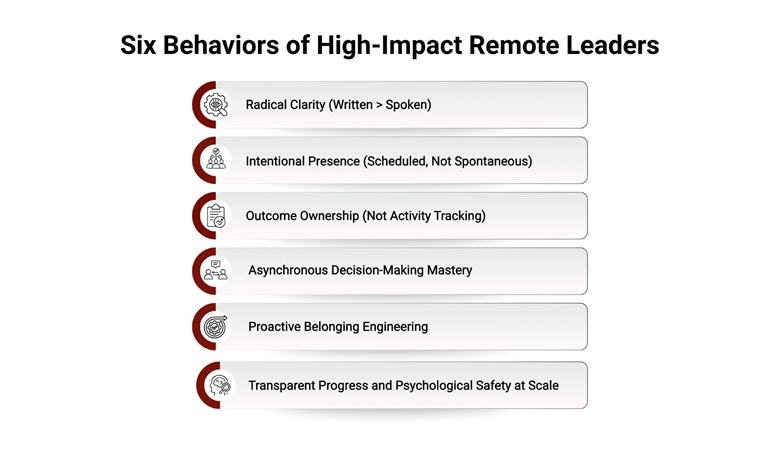
1. Radical Clarity (Written > Spoken)
Written communication becomes the primary vehicle for alignment in remote organizations. Develop comfort with documentation, recognizing that written clarity scales better than verbal explanations across asynchronous environments.
This means more than writing emails. Articulate strategy in documents, capture decisions in written records, provide feedback through thoughtful writing, and explain context through detailed documentation. The investment in written clarity pays dividends as these artifacts enable alignment without requiring synchronous presence.
2. Intentional Presence (Scheduled, Not Spontaneous)
Rather than maintaining constant availability, effective remote leaders schedule dedicated presence. They create predictable rhythms for engagement—office hours for questions, structured check-ins replacing spontaneous interactions, and deliberate time for informal conversation.
This intentionality serves dual purposes. It provides team members with reliable access while protecting the leader's time for strategic work. It also signals that presence is about quality of attention rather than quantity of hours visible.
3. Outcome Ownership (Not Activity Tracking)
Strategic implementation takes place at the edges, in customer encounters, frontline innovation, and distributed problem-solving. Trust teams to determine how work gets done while maintaining clear accountability for results.
This requires defining success through outcomes and impact rather than observable activity. Ask about progress toward objectives, quality of deliverables, and stakeholder feedback rather than monitoring hours worked or tasks completed.
The shift acknowledges that remote work makes activity monitoring both ineffective and demoralizing. Outcome ownership treats team members as professionals capable of managing their own work.
4. Asynchronous Decision-Making Mastery
Many decisions need not occur in real-time meetings. Leaders who master asynchronous decision-making use documented proposals, structured comment periods, and clear criteria to enable progress without synchronous bottlenecks.
This mastery involves several skills: framing decisions clearly in writing, identifying the right stakeholders for input, establishing deadlines for feedback, synthesizing diverse perspectives, and communicating decisions with rationale. Asynchronous decision-making accelerates organizational velocity while improving decision quality through broader input.
5. Proactive Belonging Engineering
The line between work and life is blurrier than ever, making burnout real as remote workers often struggle to disconnect. Leaders who advocate for work-life balance, encourage boundaries, and support mental well-being build resilient, loyal teams.
Belonging does not happen accidentally in remote environments. Engineer it deliberately through virtual social events, recognition rituals, inclusive practices, and explicit efforts to connect distributed team members. This engineering requires sustained attention and resources rather than hoping culture emerges organically.
6. Transparent Progress and Psychological Safety at Scale
Creating psychological safety without physical proximity requires deliberate effort. Leaders must explicitly normalize learning from mistakes, celebrate experiments, and make progress visible across the organization.
Transparency about challenges, uncertainties, and failures signals that the organization values learning over perfection. Leaders model this by sharing their own uncertainties, acknowledging mistakes openly, and demonstrating curiosity rather than judgment when things go wrong.
Making progress visible helps distributed teams understand how their work connects to broader objectives. Regular updates about organizational direction, celebrating milestones, and sharing customer impact all contribute to transparency that builds trust at scale.
.
Tools and Systems That Make Remote Leadership Work
The right technology amplifies leadership effectiveness rather than replacing it. Strategic leaders orchestrate multiple layers of tools to support distributed operations, recognizing that each layer serves distinct purposes.
1. Communication Layer (Slack/Teams + Loom + Notion)
The communication layer handles how information flows through the organization. Platforms like Slack or Microsoft Teams provide real-time messaging with channels organized around topics, teams, and projects. These tools replace office conversations with digital equivalents.
Asynchronous video tools like Loom enable explanations and demonstrations that would be inefficient in writing. Leaders can record strategy updates, walk through complex topics, or provide detailed feedback, allowing team members to consume the information on their schedule.
Centralized documentation platforms like Notion or Confluence create a single source of truth. These tools house everything from strategic plans to operational procedures, making organizational knowledge searchable and accessible regardless of time zone.
2. Alignment Layer (OKR Tools, FigJam/Discuss for Async Strategy)
The alignment layer ensures everyone understands priorities and progress. OKR (Objectives and Key Results) tools connect individual work to organizational goals, making strategy tangible and measurable. Team members can see how their projects contribute to broader objectives.
Collaborative platforms like FigJam or similar tools enable asynchronous strategy development. Teams can brainstorm, provide feedback, and refine plans without requiring everyone in the same meeting. These visual collaboration spaces replace whiteboard sessions with digital equivalents that persist across sessions.
3. Feedback Layer (Lattice, 15Five, Leapsome)
The feedback layer maintains continuous dialogue about performance and development. Tools like Lattice, 15Five, or Leapsome facilitate regular check-ins, peer feedback, and growth conversations that might otherwise get lost in remote environments.
These platforms provide structure for one-on-ones, track development goals, enable 360-degree feedback, and surface issues before they escalate. The systematic approach ensures that feedback happens consistently rather than only during annual reviews.
4. Ritual Layer (Donut, Icebreaker, SpatialChat for Social Glue)
The ritual layer deliberately creates social cohesion that offices provide through proximity. Platforms like Donut facilitate virtual coffee chats by randomly pairing team members for informal conversations. These engineered serendipity moments replace spontaneous hallway interactions.
Icebreaker and similar tools provide structured activities for team building, helping distributed colleagues learn about each other beyond work context. SpatialChat and other spatial video platforms offer informal gathering spaces that approximate watercooler conversations, allowing team members to move between conversations naturally.
Leaders who use the right tools with the right frequency may develop team cohesion even at a distance. The technology serves strategic leadership rather than replacing it, amplifying human connection and organizational alignment.
Common Remote Leadership Traps (and How to Avoid Them)
Even experienced leaders fall into predictable patterns that undermine remote effectiveness. Awareness of these traps enables proactive prevention.
1. Proximity Bias in Promotions and Recognition
Leaders unconsciously favor those they see more frequently whether in offices or on video calls. Combating this requires structured evaluation processes that assess contributions objectively rather than visibility.
2. Calendar Tyranny and Meeting Overload
The ease of scheduling virtual meetings leads to calendar saturation that prevents deep work. Meetings should be scheduled to accommodate various time zones, and leaders should set agendas to ensure they are productive and keep discussions on track.
3. Documentation Debt Accumulation
When teams fail to document decisions, rationales, and processes, institutional knowledge becomes fragmented. This debt compounds over time, creating increasing friction for new team members and strategic pivots.
4. Assuming Culture Emerges Organically
Culture is not stuck but led by daily actions, decisions, and leadership tone. Remote environments require even more deliberate cultural cultivation, as informal cultural transmission through physical proximity no longer occurs naturally.
Conclusion
The office was never the source of strategic leadership effectiveness. Alignment was. Physical proximity merely made certain aspects of alignment easier through spontaneous interaction and observable cues.
According to McKinsey, despite billions spent on transformation, 70% of digital initiatives still fail to deliver expected value, with the common scapegoats of legacy systems, talent shortages, or regulatory friction missing a deeper root cause of misalignment. This misalignment becomes even more pronounced in remote environments without deliberate structural solutions.
The best strategic leaders recognize that remote work is not a constraint to manage but an advantage to exploit. Geographic flexibility expands talent pools beyond local markets. Asynchronous operations enable continuous progress across time zones. Documentation cultures create organizational memory that survives individual departures.
Organizations that master strategic leadership at distance transform remote work from operational challenge into competitive advantage. They attract talent unconstrained by geography, operate continuously rather than bounded by office hours, and build resilience through distributed rather than concentrated operations.
The future belongs to leaders who architect alignment deliberately rather than assuming it emerges from proximity. Those who develop fluency in remote strategic leadership will define organizational effectiveness for the next decade.