What Is a Strategy Operating Model? How Organizations Turn Strategy into Execution
 June 15, 2026
A well-constructed strategy rarely fails because the thinking was wrong. It fails because the organization was never configured to carry it out. The leadership team leaves the offsite aligned with a compelling deck and clear direction, yet momentum stalls somewhere between the boardroom and front line. Decisions slow down. Teams pull in different directions. The results plateau well below what the strategy promised.
The missing piece is almost always the operating model. McKinsey research indicates that even high-performing companies have a 30% gap between their strategy’s full potential and what is actually delivered, a shortfall attributable to weaknesses in how the organization is designed to execute. That gap is an operating model problem.
Strategy and Operating Model: Understanding Where One Ends and the Other Begins
These two terms are often used interchangeably, which creates genuine confusion when organizations try to act on either. They describe different things, and the distinction has practical consequences.
Business strategy answers the question of where to compete and why the organization will win there. It addresses markets, customers, products, positioning, and the logic of value creation. It is outward-facing and concerned with choices about what the organization will and will not pursue.
A strategy operating model answers the question of how the organization will actually deliver on those choices, every day, across every function and location. It is inward-facing and concerned with how work gets done, how decisions are made, how resources are allocated, and how performance is managed.
The relationship between the two is sequential and dependent. Strategy sets the direction; the operating model configures the organization to move in that direction. When the strategy changes, the operating model typically needs to change with it, and this is where most organizations underestimate the scope of what is required.
Consider a SaaS company selling project management software on a subscription basis. The business strategy is straightforward: recurring revenue, customer segments ranging from small teams to enterprise accounts, and growth through land-and-expand motions. But delivering on that strategy requires an operating model capable of supporting 24-hour cloud reliability, responsive customer support across multiple time zones, continuous product development, and a sales motion designed for account expansion rather than transactional closure. The strategy fits on a single page. The operating model requires hundreds of deliberate decisions about people, processes, governance, and technology.
This is why strategy changes that are treated purely as communications exercises tend to stall. Announcing a new direction without reconfiguring the operating model to support it leaves the organization attempting to run new plays using infrastructure built for a different game.
What an Operating Model Actually Is
An operating model is how an organization runs day to day to deliver on its strategy. It defines who does what, how decisions get made, which technology enables the work, and how processes connect from an idea to a customer outcome. It is not the same as the organizational chart, though the structure is one part of it. It is not the same as the business model, which describes how the company creates value in the market. The operating model describes how the organization is configured internally to deliver that value reliably at scale across every team and location.
The distinction matters because the two can diverge significantly. Two companies with identical business models can run completely different operating models, and the difference in outcomes between them is often explained by that divergence. Consulting benchmarks consistently show that without an effective operating model, most organizations realize only 60 to 70% of their strategic potential, representing billions in unrealized value for large enterprises and a genuine survival risk for companies trying to scale.
The Components That Make an Operating Model Work
An operating model comprises interconnected choices that must work together. Pulling one lever in isolation, restructuring without rethinking processes, or deploying new technology without addressing governance, produces limited and often short-lived results.
The components that consistently appear in high-performing operating models include:
-
Governance and guiding principles: The rules that shape decision-making and resolve trade-offs when reasonable people disagree. Principles only create value when they are specific enough to act on. "Customer first" is a value; "when a customer issue conflicts with an internal process, resolve the customer issue and fix the process afterward" is a principle.
-
Organizational structure: Reporting lines, team design, and how the company draws boundaries between units. Nike’s 2008 redesign from product-based to sport-category organization is instructive here: shirts, shoes, and other items for each sport arrived in stores at the same time; resource allocation improved, and decisions became faster and more coherent.
-
Processes and ways of working: Define how work flows end-to-end across functions rather than through siloed departmental procedures. A European bank redesigned its account opening process from a seven-day paper-based flow to a fifteen-minute digital journey, which required coordinated changes across marketing, compliance, technology, and operations simultaneously.
-
Technology and data: The platforms and information architecture that enable or constrain what the operating model can achieve. A specialty retailer that spent years unifying inventory and point-of-sale data across 400 locations saw comparable-store sales increase 12% in the first full year after launch, because the unified data foundation made same-day delivery and ship-from-store operationally possible.
-
People, skills, and culture: The capabilities and behavioral norms that determine whether the design actually works in practice.
Why Strategy Execution Breaks Down Without This System
When organizations attempt new strategies using operating models built for a different context, execution breaks down in predictable ways. A B2B services company that decided in 2022 to pivot from project-based consulting to a digital subscription offering experienced this challenge firsthand. The strategic rationale was sound, driven by recurring revenue, better margins, and greater scalability. But the operating model was built for a different business.
Sales incentives were designed for large upfront deals, which created resistance to the land-and-expand motion that subscriptions require. Delivery teams organized around custom projects could not maintain a shared platform. Support functions built for break-fix tickets could not deliver the proactive customer success that reduces churn. Finance systems designed for one-time invoicing could not handle subscription management and usage tracking.
The company initially treated the pivot as a product launch rather than an operating model transformation. After a difficult first year, it invested in redesigning each component. By 2024, subscription revenue represented 40% of total revenue and was growing at twice the rate of traditional services.
What Ford, Nike, and IKEA Reveal About Operating Model Design
Rather than treating operating model design as an abstract exercise, it helps to examine how organizations with very different strategies have made it concrete. Ford, Nike, and IKEA each faced a specific strategic challenge, and each resolved it through operating model choices rather than strategy revisions alone.
Ford entered 2006 having lost roughly a point of US market share every year for a decade. The strategy under Alan Mulally was clear: divest noncore brands, develop fuel-efficient vehicles, and build common platforms for global markets. But execution required dismantling a structure organized around regional business units and replacing it with a global functional model. A single global head of product development reduced vehicle platforms from roughly 40 to 10. Each regional unit took on global accountability for specific vehicle categories, North America for large pickups, Europe for compact cars, Australia for small pickups, eliminating the duplication that had inflated costs and slowed decisions. Governance changed alongside structure: weekly business performance reviews were redesigned to surface problems openly rather than manage appearances. The company distributed laminated "One Ford" cards to communicate the new behavioral expectations across the entire workforce. The strategy did not rescue Ford. The operating model redesign did.
Nike in 2008 detected a shift in what its customers actually wanted. Athletes, including amateurs, were increasingly focused on high-performing, sport-specific gear rather than individual product categories. Nike’s existing structure, organized around products such as footwear, apparel, and equipment, could not respond to that preference coherently. The company redesigned its operating model around sport categories instead. Category heads were appointed, earnings were reported by sport, and products shipped together so that a season’s full range of items for a given sport arrived in stores simultaneously rather than staggered by product type. Resource allocation improved because the sport category provided a more meaningful lens for investment decisions than individual product lines. Bain research shows that companies in the top quartile on operating model indicators report decision-effectiveness scores nearly five times greater than those in the bottom quartile, and Nike’s restructuring reflects exactly the kind of seam-redrawing that drives that gap.
IKEA built its operating model around a deliberate decision to be great at a small number of things rather than adequate at everything. Its cost leadership strategy depends on two core capabilities: supplier partnerships that keep more than 95% of inventory reliably in stock, and a repeatable product design process that starts with a target price and works backward to a manufacturable design. Every operating model choice reinforces those two capabilities. Procurement units are located close to strategically important suppliers. Strong supplier evaluation forums are maintained consistently. Product development follows a standardized methodology. Nothing is gold-plated where that level of quality is unnecessary, which frees resources for the capabilities that actually create value for the customer. The operating model is not a support function at IKEA; it is the strategy made operational.
Taken together, these three examples show that operating model design is not generic. The right choices for Ford involved global integration and explicit behavioral norms. The right choices for Nike involved redrawing organizational boundaries around customer priorities. The right choices for IKEA involved disciplined capability focus and structural alignment to a small number of differentiating activities. The common thread is that each organization made deliberate choices across multiple dimensions simultaneously rather than restructuring alone.
Best Practices for Building an Operating Model That Holds
Building an operating model actually sustains performance through leadership changes, market shifts, and strategic pivots is another. The organizations that do this well share a set of consistent practices.
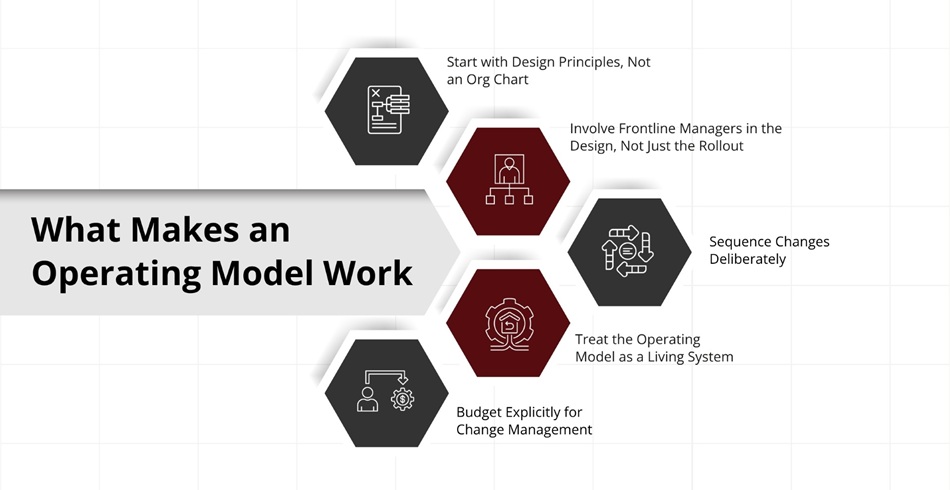
1. Start with Design Principles, Not an Org Chart.
Before drawing reporting lines, articulate a concise set of principles that describe what the organization must do to execute its strategy. Bain’s research consistently shows that effective design principles, statements like "make it easy for our distributors to do business with us" or "enable integration of future acquisitions," provide the criteria for every subsequent design decision and bring objectivity to what can otherwise become a politically charged process.
2. Involve Frontline Managers in the Design, Not Just the Rollout.
Executive-only design produces models that look coherent in a presentation but do not survive in contact with operations. Frontline managers understand where processes actually break down, where workarounds have emerged, and where policy and reality have quietly diverged. Their input during design, rather than only during implementation, produces significantly better outcomes.
3. Sequence Changes Deliberately.
Operating model transformations that attempt to change everything simultaneously tend to produce confusion rather than momentum. Redesigning three to five core processes that most directly affect customers or represent the largest sources of friction typically yields the largest performance uplift. Get that right before expanding scope.
4. Treat the Operating Model as a Living System.
Strategy refresh cycles have shortened considerably, often running on an annual or rolling basis rather than every three to five years. An operating model designed to be revisited only during major disruptions will fall out of alignment faster than it is updated. Build in quarterly retrospectives, monthly operating reviews, and defined mechanisms to detect when design choices are no longer serving the strategy.
5. Budget Explicitly for Change Management.
Only one third of transformation efforts achieve their desired outcomes, and the most common cause of failure is not poor design but poor adoption. Organizations that cut change management budgets when projects run long are removing the very investment most likely to determine whether the new model takes hold. Operating model transformation typically takes 18 to 36 months for full adoption; leaders who declare premature victory often see the organization revert to old patterns within a year.
Tools and Frameworks That Support Operating Model Design
Several analytical tools are commonly used across the strategic planning process to diagnose, design, and refine operating models.
-
McKinsey’s Organize to Value system maps 12 interconnected design elements: purpose, value agenda, structure, ecosystem, leadership, governance, processes, technology, behaviors, rewards, footprint, and talent. It is particularly useful for understanding how choices across elements reinforce or undermine each other, and for identifying which elements need the most urgent attention given in a specific strategic context.
-
Bain’s five-dimension framework structures operating model design around structure, accountabilities, governance, ways of working, and capabilities. It is especially useful for translating strategy into design principles before making structural decisions, which helps avoid the common trap of restructuring before clarifying what the structure is meant to achieve.
-
McKinsey’s 7-S framework covers strategy, structure, systems, shared values, skills, style, and staff. While developed for a more stable business environment, it remains useful as a diagnostic tool for identifying misalignments across organizational elements when beginning a redesign.
-
RACI matrices (Responsible, Accountable, Consulted, Informed) provide a practical tool for clarifying decision rights across functions and teams, particularly in matrix structures where accountability can become diffused.
-
Process mapping and value stream analysis help identify where handoffs slow work down, where duplication exists across functions, and where end-to-end ownership is unclear. These tools are most valuable when applied to the processes that most directly affect customers or represent the largest sources of operational friction.
-
Scenario-based capacity planning models how the operating model would respond to demand shocks, supply disruptions, or regulatory changes; building resilience into the design before disruption arrives rather than as a reaction to it.
No single framework is universally sufficient. The most effective operating model designs draw selectively from multiple tools based on the specific diagnostic questions the organization is trying to answer.
Closing Thought
A strategy without an operating model is a direction without a vehicle. The organizations that consistently outperform their peers are not those with the most insightful strategies. They are the ones that have built the organizational machinery to execute those strategies, day after day, across every team, in every location, without requiring heroic effort to hold it all together.
Frequently Asked Questions
Q. What is the difference between an operating model and a business model?
A. A business model describes how a company creates and captures value in the market: who the customers are, what is offered, and how revenue is generated. An operating model describes how the organization is configured internally to deliver that value, covering structure, processes, governance, technology, and people. Two companies with identical business models can run entirely different operating models, and the difference in outcomes between them is often explained by that divergence.
Q. How long does an operating model redesign take?
A. Most operating model transformations take 18 to 36 months for full adoption. The design phase typically runs three to six months, followed by phased implementation. Organizations that expect faster results often declare premature victory, only to see the organization revert to previous patterns when leadership attention shifts elsewhere.
Q. When should an organization redesign its operating model?
A. Several signals indicate that a redesign may be warranted: a persistent gap between strategic ambitions and delivered results, an inability to make decisions at the pace the market requires, costs growing faster than they can be mitigated within the current structure, or a significant strategic shift such as entering a new market, making a major acquisition, or changing the core revenue model.
Q. Does every part of the operating model need to change at once?
A. Rarely. Most effective redesigns focus first on the elements most directly misaligned with the strategy and expand from there. A full redesign of all elements simultaneously carries significant execution risk and tends to overwhelm the organization’s capacity to absorb change. The exception is when the strategy shift is fundamental enough that incremental adjustments would leave the model structurally misaligned.
Q. What is the most common reason operating model redesigns fail?
A. Underestimating cultural and behavioral changes is required. Most redesigns address the hard elements of structure, processes, and technology while underinvesting in the soft elements of leadership behavior, management norms, and reward systems. Since culture reflects what actually gets rewarded and recognized, a new operating model that leaves those systems unchanged tends to produce surface-level compliance rather than genuine adoption.
Q. How does an operating model relate to organizational agility?
A. Agility is not a property of structure alone. It emerges from the combination of clear decision rights, fast information flows, distributed accountability, and a culture that treats rapid learning as normal rather than exceptional. An operating model designed for agility makes deliberate choices across all of these dimensions rather than simply flattening the hierarchy or adopting agile terminology.