Business Model Canvas: What It Is, How It Works, and Real-World Examples
 June 24, 2026
A forty-page business plan takes weeks to write, is read by almost no one, and becomes outdated more quickly than it is revised. The Business Model Canvas was designed to replace that process with something more transparent: a single page that forces a business to articulate exactly how it creates value, who it creates it for, and how it sustains itself financially. While it may seem like a simplification, it demands discipline. Accurately defining nine building blocks requires more rigor than compiling extensive projections.
The Business Model Canvas (BMC) was developed by Alexander Osterwalder and is now used by organizations including GE, P&G, Nestlé, IBM, Ericsson, Deloitte, and the Government Services of Canada. Its appeal is not that it makes strategy easy, but that it makes strategy visible, and a strategy that can be clearly mapped is far easier to challenge, refine, and communicate across a team.
The scale of adoption reflects how broadly the tool has proven its usefulness. Over 5 million business model canvases are created every year across startups, corporations, and academic institutions, making it one of the most widely used strategy tools globally. Osterwalder’s book Business Model Generation, which introduced the canvas to a mainstream audience, has sold over one million copies across 30 languages, a reach that reflects genuine practitioner demand rather than academic interest alone.
The Nine Building Blocks and What They Actually Mean
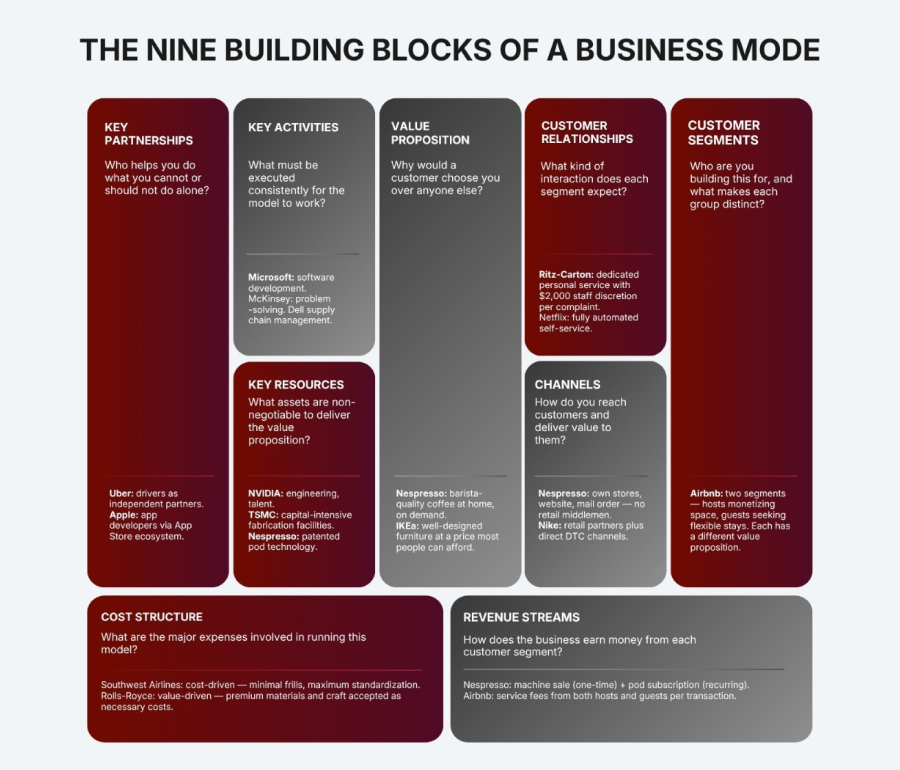
The canvas divides a business into nine components that together describe how value is created, delivered, and captured. These are not necessarily nine separate departments. They are nine lenses on a single operating logic, and the real insight comes from understanding how they connect.
The right side of the canvas deals with customers and the market: who you serve, what you offer them, how you reach them, and how you maintain relationships. The left side deals with operations: what you need, what you do, and who helps you do it. In the center sits the value proposition, which is the thing that makes the whole model coherent. At the bottom, revenue streams and cost structure determine whether the model is financially viable.
Working through each block in sequence is the most practical way to build a canvas for the first time.
-
Customer Segments: Customer Segments define who the business serves. This goes beyond age or industry; it means understanding which groups have meaningfully different needs, buying behaviors, or willingness to pay. A business model aimed at enterprise procurement teams operates differently from one aimed at individual consumers, even if the underlying product is the same.
-
Value Proposition: Value Proposition is the answer to why a customer would choose you. It describes the specific problem you solve or the need you meet for each customer segment. The most effective value propositions are precise: not "we make project management easier" but "we reduce time spent in status meetings by giving distributed teams a single source of truth." The value proposition drives everything on the right side of the canvas.
-
Channels: Channels describe how the business reaches its customer segments to deliver that value. This includes awareness, consideration, purchase, and post-purchase support. A direct-to-consumer brand using its own website operates very differently from one selling through retail distributors, even with identical products.
-
Customer Relationships: Customer Relationships define the nature of the interaction. Some businesses build personal, high-touch relationships; others run entirely on automated self-service. The choice significantly affects cost structure and should align with each customer segment’s expectations.
-
Revenue Streams: Revenue Streams describe how the business earns money from each segment. One-time transactions, recurring subscriptions, usage fees, licensing, and advertising are all distinct models with different implications for cash flow, customer lifetime value, and growth.
-
Key Resources: Key Resources are the assets the business cannot function without: physical infrastructure, intellectual property, human expertise, or financial capital. A chip designer like NVIDIA depends primarily on engineering talent; a chip manufacturer like TSMC depends on capital-intensive fabrication facilities worth billions. The same product category, entirely different resource requirements.
-
Key Activities: Key Activities are what the business must execute well to deliver its value proposition. For Microsoft, it is software development. For McKinsey, it is problem-solving. For a logistics company, it is supply chain management. Identifying these correctly helps focus organizational attention and expose where execution gaps would be most damaging.
-
Key Partnerships: Key Partnerships represent the external relationships that allow the business to do things it cannot or should not do alone. Partnerships reduce risk, expand capability, and allow access to resources without the cost of building them internally.
-
Cost Structure: Cost Structure captures the major expenses involved in running the model. Some businesses are cost-driven, building the leanest possible structure through automation and outsourcing. Others are value-driven, accepting higher costs to deliver a premium experience. Most operate somewhere between the two.
How Nespresso Used the Canvas to Reinvent a Category
The clearest illustration of how a Business Model Canvas changes strategic thinking comes from Nespresso, a fully owned subsidiary of Nestlé. Nespresso did not invent premium coffee. It reinvented the business model around it.
The commercial logic behind the model has proven durable. Nespresso generates over CHF 6.5 billion in annual revenue and maintains one of the highest customer retention rates in the premium coffee category, a performance directly attributable to the recurring revenue structure and direct customer relationship that its operating model was built around.
The traditional coffee business was transactional: sell ground coffee through retail, compete on price and shelf placement, and watch margins erode. Nespresso identified a different customer segment, home and office users willing to pay for a barista-like experience, and built a value proposition around convenience and quality rather than commodity volume.
The model worked in two stages. First, Nespresso sold its patented coffee machine through retail channels, locking customers into the system. Second, it sold proprietary coffee pods directly through its own website, stores, and mail order, eliminating the retail middlemen entirely. The result was a shift from one-time transactions to recurring revenue, from retail dependency to direct customer relationships, and from commodity pricing to premium margins.
What Airbnb and Uber Reveal About Digital Business Models
The Nespresso example shows how a canvas can reveal the logic of a reinvented business model within a traditional industry. Platform businesses like Airbnb and Uber take that logic further, building models where the most valuable asset, the matching infrastructure between supply and demand, is the one that appears least visibly on any financial statement.
On an Airbnb canvas, the customer segments are two-sided: hosts who want to monetize spare space, and guests who want affordable, flexible accommodation. The value proposition differs for each. The key resource is the platform itself, along with the review and rating system that generates trust. The key activity is platform development and community management. Revenue comes from service fees charged to both sides of the transaction, with minimal cost structure relative to a traditional hotel chain because the physical assets sit off the balance sheet entirely.
This model grows efficiently without the capital burden of traditional asset-heavy businesses. Adding one million more rooms to Airbnb’s supply requires no capital expenditure from Airbnb. The same logic applies to Uber. Both companies used the BMC, implicitly or explicitly, to stress-test a model that looked counterintuitive on paper but proved structurally sound in practice.
Discover How Data-Driven Insights Can Revolutionize Your Business Strategy.
Download the Guide
Building Your Own Canvas Without Getting It Wrong
The most common mistakes when building a Business Model Canvas are worth knowing before you start.
-
Treating it as a one-time exercise rather than a working document. The canvas should be updated as assumptions are tested and conditions change.
-
Filling it with aspirational language instead of specific, testable claims. "Best-in-class service" is not a value proposition. A specific outcome for a specific customer is.
-
Building it in isolation. A canvas developed only by senior leadership will miss the operational knowledge held by the teams who actually deliver the product or service.
-
Confusing the canvas with an implementation plan. The BMC captures the logic of the business model. Execution requires separate planning, resource allocation, and performance tracking.
The process is straightforward. Start with customer segments, because everything else is shaped by who you are building for. Move to value proposition, then channels and relationships. Define revenue streams. Then work through the left side: resources, activities, partnerships, and cost structure. Treat the first version as a hypothesis, take it to customers, and revise it based on what you learn.
How to Build a Business Model Canvas in 10 Steps
The canvas is most useful when built collaboratively, with people from across the organization rather than only from the leadership team. A finance lead sees cost structure differently from a sales lead who sees channels differently from a product manager who sees value proposition. That tension is productive, and the canvas is the right surface to work through it.
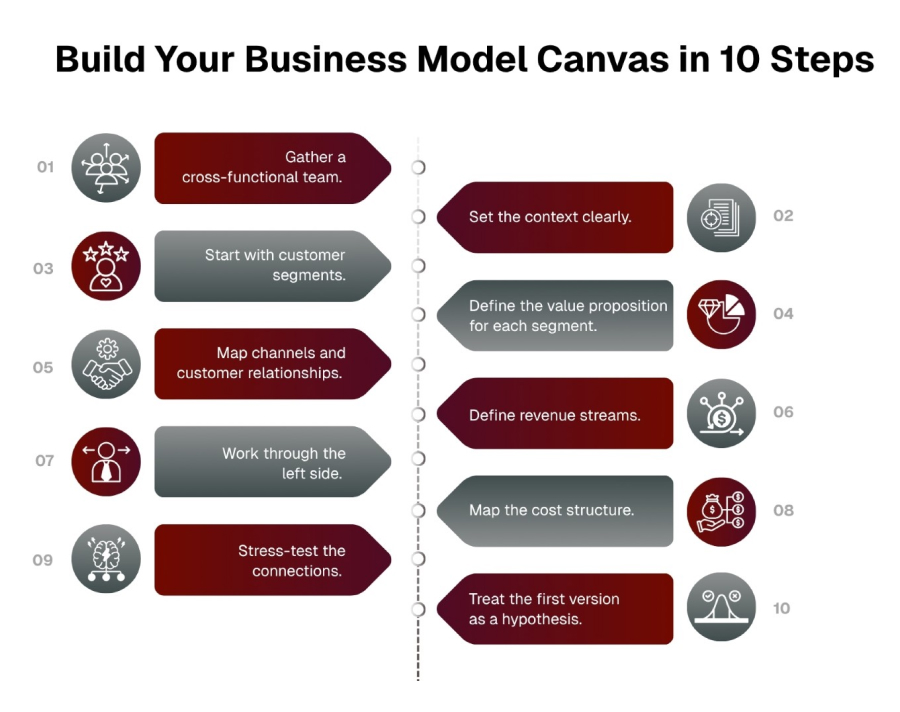
Step 1: Gather a cross-functional team.
Bring together people who understand customers, operations, technology, and finance. The diversity of perspective produces a more accurate canvas than executive consensus alone.
Step 2: Set the context clearly.
Define what you are mapping: a new product, an existing business unit, a startup idea, or the whole organization. A canvas that tries to cover everything at once tends to cover nothing well.
Step 3: Start with customer segments.
Everything else on the canvas is shaped by who you are building for. List the distinct groups of people or organizations the business serves, and note what makes each group meaningfully different from the others.
Step 4: Define the value proposition for each segment.
For each customer group, articulate specifically what problem is being solved or what need is being met. Avoid generic language; "we save time" is not a value proposition. "We reduce the time a radiologist spends reviewing routine scans by 40%" is.
Step 5: Map channels and customer relationships.
Describe how you reach each segment and what kind of ongoing relationship you maintain with them. A direct-to-consumer brand and a wholesale distributor serving the same end customer will have entirely different answers here.
Step 6: Define revenue streams.
For each customer segment, identify how the business earns money and what pricing mechanism applies. One-time transaction, subscription, usage fee, licensing, and advertising each carry different implications for cash flow and customer lifetime value.
Step 7: Work through the left side.
Identify the key resources the business cannot function without, the key activities it must execute consistently, and the key partnerships that extend its capabilities without the cost of building them in-house.
Step 8: Map the cost structure.
List the major expenses involved in running the model, distinguishing between fixed costs that do not change with volume and variable costs that do.
Step 9: Stress-test the connections.
Ask whether the revenue streams are sufficient to cover the cost structure. Ask whether the key resources and activities genuinely support the value proposition. Ask whether the channels actually reach the customer segments as described. Inconsistencies at this stage are valuable; they are cheaper to find on a canvas than in the market.
Step 10: Treat the first version as a hypothesis.
Take assumptions to customers, run small experiments, and revise the canvas as you gather real data. A canvas that never changes after the first workshop is probably not being used properly.
Conclusion
The Business Model Canvas works because it forces honesty. A business that cannot fill nine boxes with specific, coherent answers does not have a strategy problem; it has a clarity problem, and the canvas surfaces before the market does. Whether you are mapping a new venture, stress-testing an existing model, or aligning a team around a shared direction, the value of the exercise is not the finished document. It is the conversation that produces it.