When to Abandon a Strategy: The Discipline of Strategic Exit
 July 10, 2026
Leadership culture rewards persistence. The prevailing narrative celebrates the executive who holds the course through difficulty, and abandoning a strategy can feel like a public admission of failure.
This instinct carries a substantial cost. Capital, talent, and executive attention continue to flow into a strategy long after the evidence indicates it has stopped working; because the resources already committed make withdrawal feel wasteful.
The result is a slow drain on the organization, where a declining initiative consumes the very capital and talent that stronger opportunities require.
Strategic exit offers the corrective. It is a disciplined choice, not a defeat, and the most capable leaders apply the same rigor to abandoning a strategy that they applied to launching it.
This article defines strategic exit and explains why leaders delay it. It then distinguishes exit from pivoting, identifies the signals that warrant action, and outlines how to build an exit strategy and execute the withdrawal with discipline
What Strategic Exit Actually Means
Strategic exit is the deliberate, planned withdrawal from a strategy, market, product line, or business model that no longer advances the organization's objectives. The defining characteristic is intention. A strategic exit is a controlled choice made on its own terms, which separates it from the disorderly collapse that follows when leaders ignore the warning signs for too long.
The decision takes one of three forms, and the right choice depends on whether the underlying capability still holds value:
-
Full withdrawal. A full withdrawal means leaving a market or discontinuing a product entirely. This form applies when the position holds no recoverable value and no capability worth carrying forward
-
Pivot. A pivot redirects the core capability toward a new direction while exiting the old position. This form applies when the original market no longer works but the underlying strength transfers to a different opportunity.
-
Restructuring. Restructuring retains the underlying business but fundamentally changes how it operates. This form applies when the strategy remains sound and the execution model requires repair.
Each form addresses a distinct situation which makes the initial diagnosis the most consequential step.
Why Leaders Hold On Too Long
The decision to persist with a failing strategy is rarely a product of careless analysis. It results from a set of psychological and structural forces that operate against clear judgment, even among experienced leaders. Four forces account for the bulk of delayed exits.
-
Sunk cost reasoning. Prior investment of money and time distorts forward-looking judgment. Leaders weigh what has already been spent, although that capital is unrecoverable and irrelevant to the choice about future commitment.
-
Identity and ego. A strategy is frequently tied to the leader who championed it. Abandoning the initiative can feel like a personal repudiation, which raises the emotional stakes of an objective business judgment.
-
Escalation of commitment. Leaders increase their investment in a failing course of action to justify the choices that came before. Each additional commitment deepens the difficulty of eventual withdrawal.
-
Optimism bias. The belief that recovery sits just one quarter away sustains commitment well past the point of reasonable expectation. The forward projection rests on optimism rather than the available evidence.
The financial consequences of these forces are documented. According to Bain & Company's analysis of more than 24,000 transformation initiatives, 88% of business transformations fail to achieve their original ambitions.
The figure indicates that persistence alone does not rescue a strategy that the evidence has already invalidated, which makes the discipline of timely exit a central leadership competency rather than a peripheral one.
The pattern also reframes how leaders should interpret early difficulty. A struggling strategy is not automatically a failing one, and the task is to distinguish the initiative that needs more time from the initiative that needs to end.
Also Read - The Hidden Cost of Copying Competitors in Your Brand Strategy
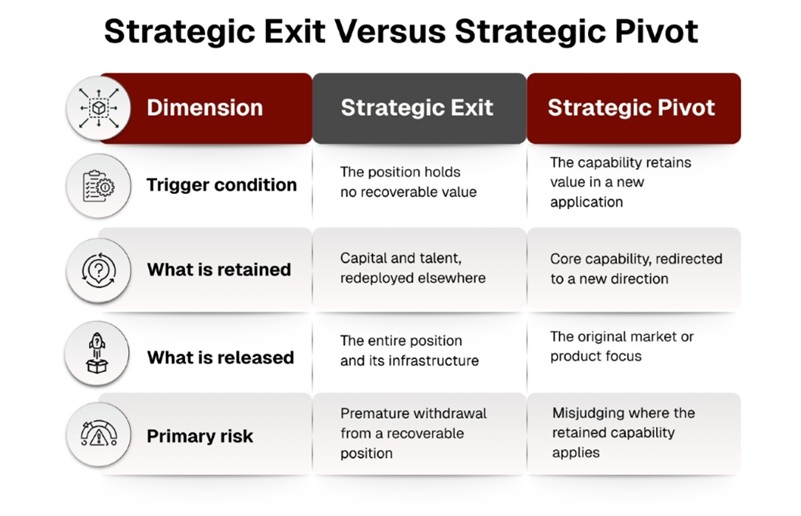
Strategic Exit Versus Strategic Pivot
Exit and pivot are related decisions with an important distinction.
A strategic exit involves withdrawing from a position entirely and reallocating the released resources elsewhere.
A strategic pivot involves redirecting the organization's core capability toward a new opportunity while exiting the original position. The pivot retains something useful from the prior effort, whereas the full exit releases the position completely.
The distinction matters because the two paths carry different risk profiles and require different preparation.
A pivot requires an honest assessment of which capabilities genuinely transfer, since a misjudged pivot carries the original problem into a new context under the appearance of change.
A full exit demands confidence that the position holds no recoverable value, since a premature withdrawal surrenders ground that disciplined effort might have held.
Leaders who confuse the two tend to pivot when they should exit, which preserves a failing commitment in a new form rather than releasing it.
The Signals That Tell You It Is Time
A disciplined exit depends on identifiable signals rather than instinct. Leaders who define these indicators in advance can recognize the moment for action before the organization's resources are fully depleted.
Five signals consistently warrant a formal exit review.
-
Sustained underperformance against defined metrics. When a strategy misses clearly established targets over multiple measurement periods, the shortfall reflects a structural problem rather than a temporary setback.
-
A structural market shift. When the conditions that justified the original strategy change permanently, the thesis behind the initiative no longer holds, regardless of execution quality.
-
Resource drain on higher-potential initiatives. When a declining strategy consumes the capital and talent stronger opportunities require, the organization pays an opportunity cost that compounds over time.
-
Erosion of competitive advantage. When a competitor establishes an advantage the organization cannot realistically rebuild, continued investment in the contested position yields diminishing returns.
-
Misalignment with redefined objectives. When the organization's long-term goals shift, a strategy built for the prior objectives may no longer serve the current direction.
The reliability of these signals depends on the quality of the metrics behind them, which is a function of disciplined strategy design from the outset.
Organizations that establish clear performance metrics from the outset are far better positioned to recognize when a strategy requires adjustment or exit. This article on building a winning business strategy explores the planning and measurement principles that make those decisions possible.
How to Exit a Strategy With Discipline
A strategic exit executed without structure can damage stakeholder confidence and waste the value an orderly withdrawal preserves. A disciplined exit strategy protects both.
Five steps form the foundation.
-
Step 1: Define the exit criteria in advance. Establish the conditions that will trigger withdrawal at the moment you launch the strategy, before any emotional investment accumulates.
-
Step 2: Separate the decision from the decision-maker. Assign the exit review to a party with no personal stake in the original strategy. Independent evaluation neutralizes the ego and escalation pressures that distort the judgment of the initiative's champion.
-
Step 3: Quantify the cost of continuation. Compare the forward cost of persisting against the opportunity cost of the capital and people involved, and exclude sunk cost from the calculation entirely. The discipline lies in valuing them at their next-best use rather than their current one, because a team retained on a declining initiative carries the hidden cost of the stronger work it cannot pursue. A strategy that looks marginally profitable in isolation often proves a net loss against the alternatives.
-
Step 4: Plan the resource redeployment process. Treat the exit as a reallocation rather than a termination. Determine where the freed capital and talent will generate stronger returns, since an exit without a redeployment plan surrenders its primary benefit.
-
Step 5: Communicate the rationale clearly. Frame the withdrawal as a deliberate strategic choice supported by evidence. A clear rationale protects stakeholder confidence and distinguishes a disciplined exit from a reactive retreat.
Turning Exit Into Advantage
A well-executed exit is a source of strength rather than a concession. The capital and talent freed from a declining strategy become available for higher-potential opportunities, which turns the exit into a reallocation that strengthens the broader portfolio.
The advantage grows when the business preserves what the prior effort built. An underperforming strategy often leaves behind capabilities, data, customer relationships, or infrastructure that hold value elsewhere. A disciplined exit identifies these assets before withdrawal and redirects them toward the next initiative.
Netflix illustrates the principle. The company built its original business on DVD-by-mail rentals, a profitable operation even as streaming emerged. Rather than defend the declining segment, Netflix concentrated its resources on streaming and wound down the DVD service in September 2023 after 25 years.
Co-CEO Ted Sarandos made the logic explicit in a 2021 interview, noting that any energy spent saving the DVD business was energy not spent building streaming. The subscription and recommendation systems developed during the DVD era then became foundations of the streaming operation that replaced it.
The judgment to time and execute an exit of this kind is an advanced strategic competency.
The ability to evaluate opportunity cost, assess strategic alternatives, and make high-stakes resource allocation decisions is a hallmark of advanced business strategy leadership. Programs such as Senior Business Strategy Professional (SBSP™) help leaders strengthen these capabilities through structured strategic decision-making frameworks
Conclusion
The half-life of a business strategy continues to shorten as markets grow more volatile and competitive conditions shift faster. In this environment, the capacity to abandon a strategy with discipline becomes a renewable source of competitive strength rather than a one-time admission of defeat.
Leaders who treat strategic exit as a core competency, supported by predefined criteria and independent review, protect their organizations from the slow erosion that follows misplaced persistence. The decision to withdraw, executed well, reflects strategic maturity at its most demanding.