AI-Native Strategy: Rebuilding the Business Around AI
 July 02, 2026
Companies now use AI somewhere in their operations, yet their strategy and operating model look much as they did before. A chatbot handles support tickets and a copilot drafts code, even as the core of the business continues to rely on the same processes it always has.
A bolt-on approach improves local efficiency; in contrast, some competitors rebuild their operations around AI, changing capabilities and cost structures.
The distance between the two groups widens each quarter, because compounding advantages in speed and cost are hard to catch. Once a rival serves customers faster and at lower cost, price and service expectations shift across the market, and a slow follower inherits a problem it did not choose.
This is the shift toward AI-native strategy.
The following sections define AI-native strategy and explain why this shift is accelerating. They also outline how leading firms rebuild around AI and what it demands from leaders.
What AI-Native Strategy Means
AI-native strategy is a business strategy in which artificial intelligence sits at the core of how an organization creates and delivers value. The business is designed around AI from the outset, so its operating model and its products take shape around what AI can do. The term describes where AI sits in the strategy rather than how much of it a company uses.
Three traits set an AI-native strategy apart:
-
AI as the foundation: It shapes how the whole business runs, from its products to its daily operations, so AI is the starting point rather than an add-on.
-
Design that begins with AI: The guiding question is how the company would build itself today with AI at the center, and the operating model follows from the answer.
-
Work rebuilt around AI: Core processes are redesigned to use what AI makes possible, and people focus on the judgment calls AI should not own. This is closer to reconstruction than to a software upgrade.
A short example makes the line clear. An AI-enabled insurer adds a model that flags risky claims faster for the same adjusters to review. An AI-native insurer rebuilds underwriting so the model prices and approves standard policies on its own and routes only the unusual cases to people. The technology is the same, but the business that results is not. This is why an AI-native approach has become integral to digital business models rather than remaining experimental.
AI-Native vs. AI-Enabled: Where They Diverge
The contrast becomes concrete in a side-by-side comparison. Each row marks a decision where AI-enabled and AI-native businesses take different paths.
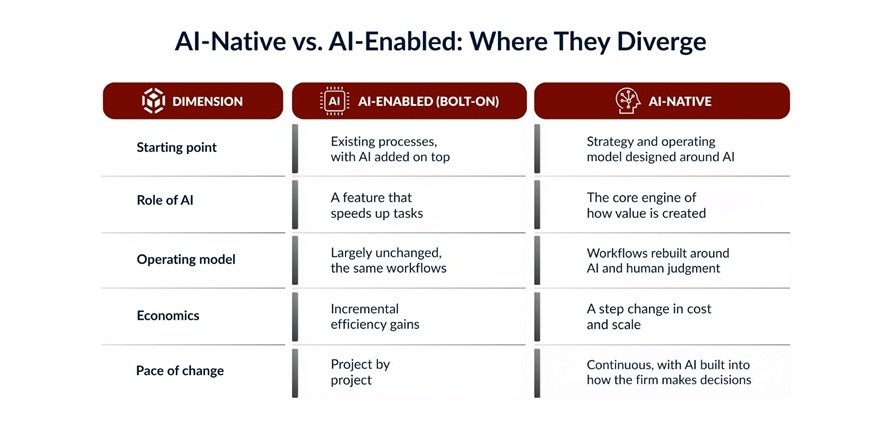
The operating-model and economics rows carry the greatest weight. Incremental efficiency improves a margin, whereas a redesigned operating model changes the cost curve and lets a smaller team serve far more customers. That is the kind of gain a competitor cannot match by adding another tool.
Reversibility tells a similar story. An AI-enabled change can be switched off without much disruption, while an AI-native redesign reshapes roles and economics in ways that are costly to undo. That cost of reversal is part of what makes the advantage durable.
Why the Shift Is Accelerating Now
As the two paths diverge, the AI-native side pulls ahead faster, and timing is the reason. Three forces have matured together and reinforce one another:
-
Capability: Models have grown capable enough to handle real work, well past the demo stage.
-
Falling cost: The price per task keeps dropping, which makes a full redesign of whole processes worthwhile.
-
First-mover advantage: Competitors that move first convert that head start into data and customer relationships that latecomers struggle to win back.
The data shows how few firms have crossed over. McKinsey’s The State of AI in 2025 report found that only 39% of organizations see enterprise-level financial impact from AI, even though adoption is now widespread. The roughly 6% it labels AI high performers stand apart for one reason. They rebuild around the technology and redesign their workflows, instead of layering AI on top of what already exists.
The strategic takeaway is clear. Value follows the firms that change how work is performed, well ahead of those that simply own more tools. Broad AI adoption no longer marks a leader, because the real divide is how much of the business a company lets AI reshape.
The effect is already visible where AI-native entrants compete. A lean team that runs AI across its core can match the output of a far larger rival and undercut its prices and still protect its margins. That pressure forces incumbents to respond on a timeline they did not set. Inaction carries its own cost here, because the market resets around the new pace whether or not a given firm takes part.
How Businesses Are Rebuilding Around AI
Rebuilding around AI shows up in four parts of the business. A genuine AI-native strategy moves on each of them at once, since a change in one exposes the limits of the others.
-
Workflows and the operating model: Teams redesign core processes so AI handles the routine path and people handle the exceptions. A claims process or a sales motion is rebuilt instead of accelerated, which lowers the cost and the time the work takes.
-
Business models: AI-driven business models open pricing and products that were not viable before, such as a service priced per outcome instead of per seat. As the cost of delivery falls, offers that once lost money start to make sense.
-
Decision-making: Data and models move into the daily decision loop, so forecasts and pricing update continuously rather than once a quarter. Decisions move faster and stay grounded in current conditions instead of waiting on a planning cycle.
-
Talent and structure: Roles shift toward judgment and the oversight of AI systems, and the org chart flattens as small teams do work that once needed large ones. The scarce skill becomes knowing what to ask of AI and how to check what it returns.
Consider how a software company might rebuild support. Instead of adding a chatbot in front of the same ticket queue, it lets AI resolve routine issues end to end and escalates the hard cases with full context. Each resolution feeds back into the product, so the same issue stops recurring. Headcount no longer scales with ticket volume, and a former cost center becomes a source of product insight.
The firms that win here run these four as one connected program, because an AI-native operating model cannot sit on top of a business model and talent structure built for a pre-AI era. That is why AI business transformation often stalls. The technology is ready well before the organization around it.
What AI-Native Strategy Demands of Leaders
The weight of this rebuild falls on leadership. Three demands shape how far it goes:
-
A decision on where AI belongs: Leaders set where AI sits in the value chain and how to govern its risks.
-
Governance as a design choice: Models that shape real decisions can fail in ways a spreadsheet never did, so governance moves from a compliance afterthought to a core part of the design.
-
Fluency across the organization: Models become measurable results only when fluency reaches beyond the top team, so managers across the business can frame problems for AI and judge its output.
That work rewards a deliberate grounding in strategy rather than ad hoc reaction. Leaders need a shared framework to read the market and model options, then steer execution as conditions change.
For senior professionals who want to lead this kind of transformation, The Strategy Institute’s Senior Business Strategy Professional (SBSP™) certification builds advanced capability in disruptive strategy and enterprise execution, the capabilities an AI-native shift demands.
Sequencing the changes presents a greater challenge. A leader decides what to rebuild first and how to fund it while the current model still generates revenue, then how fast to move before the advantage closes. The core of the job is to keep strategy ahead of tooling. The technology will keep changing, and the discipline of choosing where it creates durable advantage is what endures.
AI-native strategy is a reset rather than a one-off project. Companies that treat it as a feature gain small, local efficiencies as the wider market moves ahead of them. Companies that redesign their operations around AI build a cost and speed advantage competitors struggle to match.
Leadership teams can commit to that redesign now, or spend the next few years catching up. The advantage is largest for early movers and shrinks as more competitors adopt the same approach.