Niche Market Strategy: The Complete Approach to Dominating Your Segment
 December 24, 2025
While your competitors burn through budgets battling for market share, there's a corner of the marketplace where you can charge double and customers will thank you for it. It's called a niche market, and it might be the most underutilized strategy in business today.
Unlike broad market approaches that spread resources thin, niche marketing focuses on serving a specific segment with surgical precision. This strategy isn't just for small businesses with limited budgets, even global corporations like Toyota, Red Bull, and Rolls-Royce use niche strategies to dominate specialized segments.
This comprehensive article explores how businesses can identify, target, and dominate markets using the strategic niche targeting model and proven implementation frameworks.
What is a Niche Market Strategy?
A niche market strategy is a unique marketing approach that focuses on selling or promoting specialized products or services to a small but highly productive target group. Instead of targeting everyone, businesses concentrate on customers who can relate deeply to their particular offerings.
Many business owners falsely believe that profitability depends directly on the number of potential customers targeted. This approach challenges this assumption by prioritizing quality over quantity. The market size may be smaller, but customers are willing to pay more for specialized solutions that precisely meet their needs
Key Benefits of Niche Marketing for Businesses
A focused business strategy targeting specific segments delivers multiple competitive advantages:
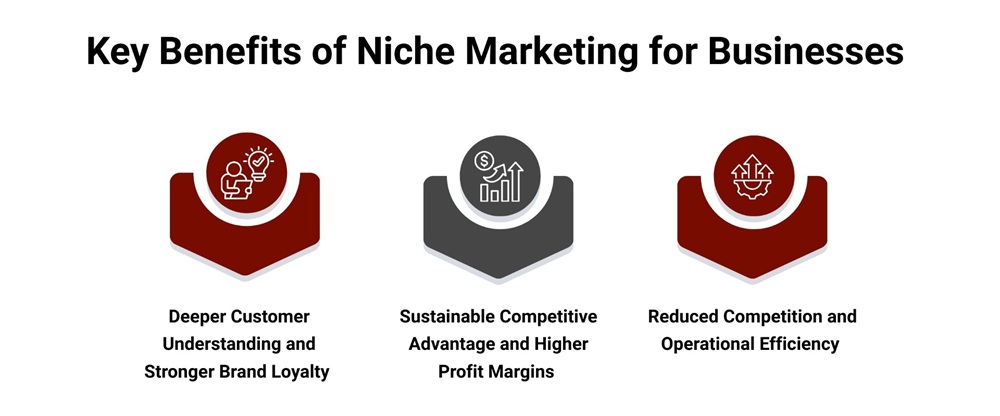
1. Deeper Customer Understanding and Stronger Brand Loyalty
By concentrating on a specific market segment, businesses gain granular insights into customer preferences, behaviors, and pain points that would be impossible to achieve with a broad-market approach. This intimate knowledge of segment-specific challenges enables companies to develop more relevant product development roadmaps that truly address what customers need rather than generic solutions that satisfy no one completely.
This depth of understanding naturally translates into stronger brand loyalty as businesses foster deeper emotional connections with customers who feel truly seen and understood.
2. Sustainable Competitive Advantage and Higher Profit Margins
Niche marketing creates sustainable competitive advantages by allowing businesses to differentiate from broad-market competitors and become the go-to solution for their target market. Companies build expertise that's difficult to replicate, creating moats around their market position that protect them from easy imitation. This specialization enables businesses to command premium prices, as customers recognize and value the focused expertise being offered.
By serving unique needs that generalist competitors can't adequately address, businesses reduce price competition and achieve better returns on marketing investments.
3. Reduced Competition and Operational Efficiency
Perhaps counterintuitively, narrowing focus actually expands opportunity by reducing direct competition. Businesses face fewer competitors in specialized spaces and create barriers to entry through their specialized expertise, avoiding resource-intensive battles with market leaders who dominate broader segments. This competitive breathing room combines with operational advantages that make the business more efficient across the board.
The result is a leaner, more focused organization that delivers superior value to its chosen market while operating more profitably than broader competitors.
The Strategic Niche Targeting Model: Advanced Framework
Strategic targeting lets you dominate ultra-specific customer groups that competitors overlook. This five-part framework shows how to find hidden opportunities, own them completely, and build a profitable moat others can’t touch.
Component 1: Micro-Market Segmentation Analysis
Unlike traditional market segmentation, this component focuses on hyper-granular market dissection that reveals opportunities invisible to broader competitors. The practical application of this approach transforms vague targeting into laser-focused precision.
Instead of targeting "fitness enthusiasts," for example, you drill down to "home rehabilitation equipment for post-surgery recovery in adults 50+." This level of specificity allows you to understand and serve your customers in ways that generalist competitors simply cannot match.
Component 2: Competitive White Space Mapping
This critical stage involves identifying unexplored or underserved market territories that present strategic opportunities. The process begins with conducting comprehensive competitive landscape analysis by mapping all current players in the broader market.
Next, you detect gaps in current market offerings by documenting unmet customer needs, identifying underserved customer segments, and finding quality or service gaps in existing solutions.
Finally, you evaluate potential entry points by assessing barriers to entry for each white space, calculating investment requirements, and estimating time to market leadership.
Component 3: Precision Positioning Strategy
Developing a targeted value proposition that speaks directly to the identified micro-market requires attention to three core elements.
First, hyper-specific messaging means crafting language that resonates with segment-specific pain points, addressing unique concerns that generalist competitors ignore, and using terminology and references familiar to the audience.
Second, tailored product or service configurations involve designing features specifically for requirements, removing unnecessary features that don't serve the segment, and optimizing pricing for perceived value within the niche.
Third, unique value delivery mechanisms require creating distribution channels suited to preferences, developing customer service approaches aligned with segment expectations, and building community and educational resources that reinforce your position as the specialist. This precision positioning makes your offering feel custom-built for your target segment rather than adapted from a broader solution.
Component 4: Dynamic Capability Assessment
Evaluating organizational capabilities to authentically serve the identified niche ensures you can deliver on your positioning promises.
The assessment framework begins by analyzing internal competencies including technical expertise and knowledge, production or service delivery capabilities, marketing and sales proficiency, and customer support infrastructure.
Next, you identify skill and resource gaps such as required certifications or credentials, technology or equipment needs, personnel with specialized knowledge, and partnership or outsourcing requirements.
Finally, you develop strategic adaptation strategies through training and development programs, recruitment of specialists, technology investments, and strategic partnerships or acquisitions. This honest assessment prevents the common mistake of positioning a niche you cannot adequately serve, which damages credibility and wastes the opportunity.
Component 5: Scalability and Expansion Modeling
Unlike traditional strategies that risk market limitations, this component incorporates strategic expansion pathways that prevent you from outgrowing your market.
Planning considerations include identifying adjacent market segments by finding natural extensions of your core niche, mapping skill and capability transferability, and assessing expansion timing and sequencing. You also develop modular capabilities by building flexible operational systems, developing adaptable product platforms, and creating scalable service delivery models.
Additionally, you create flexible strategic frameworks by designing decision-making processes for rapid pivots, establishing metrics for expansion of readiness, and creating scenario plans for market evolution. This forward-thinking approach ensures that dominating your initial niche becomes a springboard for sustainable growth rather than a limiting constraint, allowing you to expand strategically when the time is right while maintaining the depth of expertise that made you successful in the first place.
Critical Success Factors for Niche Strategy
The following four proven factors separate thriving players from those who struggle. Master them, and you’ll build a loyal, profitable business.

Factor 1: Unique Customer Needs
The foundation of any successful market strategy is targeting customers with needs different from general market requirements. These needs must be specific and well-defined; customers must recognize and value the difference, and solutions must be meaningfully differentiated from mainstream offerings.
The key is ensuring that your target customers experience genuine pain points that generalist competitors either don't recognize or choose not to serve because the market appears too small or specialized.
Example: Lush Cosmetics targets consumers who refuse mass-produced products with synthetic ingredients and demand fresh, handmade, cruelty-free alternatives.
Factor 2: Sufficient Market Size
The market size must support sustainable, profitable business operations, requiring careful assessment across multiple dimensions. Market viability assessment involves calculating total addressable market, estimating realistic market share potential, and projecting revenue at various penetration rates to ensure the opportunity justifies the investment.
While the market is small compared to mass markets, the focus is on quality over quantity.
Example: Crosley Radio revived vintage-style turntables for vinyl collectors and retro enthusiasts. The niche was small in 1998, but the vinyl resurgence turned it into a multimillion-dollar category.
Factor 3: Manageable Competition
Competition exists even in niche segments, but the competitive dynamics differ fundamentally from mass markets. Your competitive analysis must address differentiation requirements by identifying your unique competitive advantages. You also need to assess competition levels by evaluating whether all players can coexist profitably.
Example: In the ultra-premium mattress space, Saatva competes against only a handful of direct-to-consumer players (not Tempur-Pedic or Serta). Clear differentiation (white-glove delivery, 365-night trials) and high switching costs keep margins strong.
Factor 4: Effective Communication Channels
Success requires identifying and effectively communicating with the target segment through channels where they actually spend time and attention.
Channel identification answers critical questions:
-
Where does your niche audience gather?
-
What media do they consume?
-
Who influences their decisions?
Understanding these patterns allows you to concentrate on marketing resources where they'll have maximum impact rather than spreading budgets across channels your customers don't use.
Example: Dr. Squatch built a $100M+ men’s natural soap brand almost entirely through hyper-targeted YouTube ads and TikTok comedy sketches that speak directly to guys tired of “chemical-filled” drugstore body wash.
Step-by-Step Implementation to Niche Market Framework
This implementation breaks down the journey into five manageable phases spanning 26 weeks, taking you from initial research through market entry to sustained growth.
Phase 1: Research and Analysis (Weeks 1-4)
The foundation of successful niche targeting begins with thorough research across two critical dimensions. Market research involves conducting comprehensive market analysis, identifying potential opportunities, analyzing competitive markets, and validating market size and growth potential to ensure you're pursuing viable opportunities rather than dead ends.
Simultaneously, customer research requires developing detailed customer personas, and conducting interviews with potential customers to understand their real needs rather than assumed ones.
Phase 2: Strategy Development (Weeks 5-8)
With solid research in hand, the next phase translates insights into concrete strategic decisions. Selection involves evaluating opportunities against your organizational capabilities, and assessing competitive dynamics to ensure you can win.
Once your niche is selected, value proposition development becomes critical. This means crafting a compelling positioning statement that resonates with your target segment.
Phase 3: Brand and Product Development (Weeks 9-16)
The longest phase focuses on building the tangible elements that will bring your strategy to life. Brand building requires developing brand identity and messaging that speaks directly to your audience.
Parallel to brand work, product or service refinement involves tailoring offerings to requirements by adding or removing features based on what your segment actually needs.
Phase 4: Launch and Growth (Weeks 17-26)
With brand and product ready, you execute your market entry by launching campaigns in channels where your audience congregates. The second half of this phase focuses on optimization and scaling by gathering customer feedback to understand the real customer experience.
Phase 5: Measurement and Evolution (Ongoing)
The final phase never truly ends, as successful businesses continuously adapt to maintain their edge. Performance tracking involves monitoring all key performance indicators that signal business health, and conducting regular market assessments to spot emerging trends or threats.
Strategic adaptation uses these insights to adjust strategies based on performance and identify new opportunities within or adjacent to your core business.
Conclusion: Your Path to Niche Dominance
A well-executed niche market strategy can be a powerful driver of business growth and profitability. By carefully selecting a target segment, developing deep customer understanding, building strong brand presence, and effectively managing challenges, businesses can achieve dominance.
Run a quick but honest SWOT analysis on your business (or yourself). Identify the strengths only you bring to the table, deep expertise, unique assets, proprietary data, or hard-won relationships. Then scan the market for underserved customer groups whose biggest pain points line up perfectly with those strengths.
From there, double down and build specialized capabilities (processes, features, credentials, or partnerships) that bigger players can’t or won’t replicate.
That intersection of your unique strengths + their unmet needs is your true competitive moat.
Find it, own it, and the segment becomes yours for good.