Why Women Leadership Drives Business Success: 12 Strategies That Work
 March 06, 2026
The numbers tell a compelling story about women in leadership. Women hold 29% of C-suite positions, up from just 17% in 2015, according to McKinsey research. That growth reflects changing attitudes, but it also reveals persistent gaps. While women occupy 40% of C-suite roles in Fortune 500 companies, only 10% serve as CEOs.
Organizations miss measurable benefits when women aren't represented in leadership. According to McKinsey's 2023 "Diversity Matters Even More" report, companies with top-quartile gender-diverse executive teams are 21% more likely to outperform on profitability, measured by EBIT margin. The case strengthens further when ethnic diversity is added: those same top-quartile companies show 39% greater likelihood of financial outperformance. That performance advantage comes from different leadership approaches, diverse perspectives, and capabilities that complement traditional management styles.
Understanding why female leadership matters and how women can develop these capabilities creates opportunities for individuals and organizations alike.
Why does Female Leadership Improve Business Performance?
-
Better decision-making through diverse perspectives
-
Higher employee engagement and retention
-
Stronger innovation and risk management
-
Improved financial performance
What Women Leaders Bring to Organizations?
Female leadership refers to leadership approaches commonly demonstrated by women that emphasize collaboration, empathy, inclusion, and long-term value creation.
Women tend to adopt transformational leadership styles that focus on developing team members' full potential. Rather than simply managing tasks, transformational leaders create lasting positive change in both people and organizations.
This approach shows specific behaviors. Women leaders tend to turn routine meetings into collaborative strategy sessions where every voice matters. They convert performance reviews into growth-focused development plans. When challenges arise, they facilitate team problem-solving rather than just delegating tasks.
The distinction matters because transformational leadership consistently predicts higher work unit effectiveness across various industries. This helps explain why organizations with strong female leadership tend to outperform their peers. The leadership style drives measurable business results.
The number of female CEOs in the Fortune 500 reached 55 in 2025. That figure represents both progress and persistent underrepresentation. Yet the companies on that list consistently appear in research linking diverse leadership to stronger financial performance, a pattern that holds across multiple studies, industries, and time periods even when controlling other variables.
The Real Challenges Women Leaders Face
Understanding the importance of female leadership requires acknowledging the barriers that limit it. Recent McKinsey research reveals troubling trends. Only half of companies (50%) are prioritizing women's career advancement, part of a multi-year decline in commitment to gender diversity. This systemic deprioritization creates tangible obstacles.
The challenges start early. At the first promotion to manager, only 93 women are promoted for every 100 men. The gap widens dramatically for women of color, with just 74 promoted for every 100 men. This "broken rung" at the entry to leadership creates pipeline problems that persist throughout careers.
Traditional gender roles create expectations that women should prioritize home over careers, leading to limited opportunities or career breaks. Unlike men, women face harsher judgment for spending long hours at work, as if they're neglecting family responsibilities.
Girls are often labeled 'bossy' for speaking up, unlike boys called 'leaders' for the same behavior, discouraging women from pursuing leadership. This phenomenon affects why women are less likely to pursue leadership opportunities.
The double bind continues in professional settings. Strong female leaders get labeled "too aggressive," while men showing the same traits are called "confident" and "decisive." Limited support systems, lack of accessible childcare, and inflexible work arrangements make advancement harder. Many women feel guilty for not being "perfect" in both family and professional roles, leading to burnout.
In some cultures, resistance to women leading, especially over men, creates additional barriers women must overcome.
How Organizations Can Support Women Leaders?
Empowering women in leadership requires more than individual effort. Organizations must actively create environments where women can thrive. The data reveals why this matters. Research shows an ambition gap: 69% of entry-level women want promotion versus 80% of entry-level men. At senior levels, 84% of women seek advancement compared to 92% of men.
Critically, this gap disappears when women receive the same career support as men. This proves that lower ambition among women isn't innate but rather a response to unequal support and opportunity.
Challenge bias and stereotypes by actively addressing unconscious bias in hiring, promotions, and decision making. Recognize leadership qualities without gender-based labels. Provide mentorship and sponsorship where women benefit from guidance, advocacy, and visible role models who can help open doors and navigate challenges.
Offer flexible work policies including work-from-home options, flexible hours, and childcare support that help balance family and career without forcing a choice between them. Celebrate achievements publicly by recognizing women's accomplishments with the same visibility and enthusiasm given to male leaders.
Ensure equal access to opportunities by giving women the same stretch assignments, training programs, and networking opportunities that prepare leaders for senior roles. Create safe spaces that encourage open conversations about challenges related to work-life balance, bias, or career development without fear of judgment.
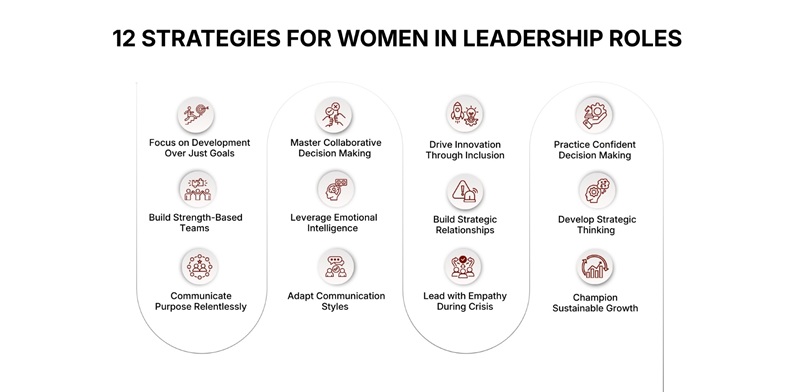
12 Strategies for Women in Leadership Roles
These approaches help women leverage natural strengths while developing capabilities that drive business results.
1. Focus on Development Over Just Goals
Setting and achieving goals matters for business success. However, transformational leaders see employee development as the path to achieving those goals. Women leaders should aim to accomplish objectives by transforming teams into more capable people.
This means spending more time engaging with team members on a personal level, looking for ways to inspire motivation in accomplishing goals, and emphasizing teamwork and authentic communication. Invest time in coaching team members and care about their personal development. Seek to be a role model who inspires rather than just directs.
2. Build Strength-Based Teams
Effective women leaders assign responsibilities according to individual strengths rather than availability or workload alone. Understanding what each team member excels at and genuinely enjoys enables more purposeful delegation. Aligning tasks with natural capabilities increases both performance and engagement, as people contribute most effectively when their work draws on what they do best.
The best way to discover this is spending time engaging with teams on a personal level. Find out their inside and outside of work strengths. They might surprise you. Consider using personality assessments to better understand individual capabilities and preferences.
3. Communicate Purpose Relentlessly
Research shows employees are more engaged when they understand how their work contributes to a larger purpose. Purpose-driven leaders excel at connecting daily tasks to meaningful outcomes, helping team members see beyond immediate goals to understand their broader impact.
Share the organization's vision and values regularly. Help team members understand their role in the bigger picture. Celebrate meaningful achievements beyond just numerical targets. Create regular touchpoints where team members can share how their work aligns with their personal values and the organization's mission.
4. Master Collaborative Decision Making
Traditional leadership often centralizes decision making at the top. However, transformational leaders recognize that the best solutions often emerge from diverse perspectives and collective wisdom. They create environments where team members feel empowered to contribute ideas and participate in decisions.
This approach builds trust, increases buy-in and leads to better outcomes. When team members participate in decisions affecting their work, they become more invested in the success of those initiatives. Diverse teams make better decisions 87% of the time, according to research.
5. Leverage Emotional Intelligence
The ability to understand and manage emotions, both your own and others, marks the difference between good and exceptional leaders. Women often excel in emotional intelligence, bringing nuanced understanding to complex workplace dynamics.
Use emotional intelligence to read the room during challenging conversations, navigate conflicts before they escalate, and build stronger connections across teams. This capability helps leaders manage team dynamics effectively, resolve conflicts efficiently, and build strong interpersonal relationships.
6. Adapt Communication Styles
Master communicators know that one size doesn't fit all. Different team members respond to different communication approaches, and various situations call for distinct styles. The key lies in flexibility, knowing when to be direct, when to nurture, and when to inspire.
Observe how each team member prefers to receive feedback. Practice switching between communication styles based on context. Ask for feedback on your communication effectiveness. This adaptability ensures messages land effectively regardless of audience or situation.
7. Drive Innovation Through Inclusion
When leaders create truly inclusive environments, innovation naturally follows. This goes beyond basic diversity initiatives to create spaces where different perspectives are actively sought and valued.
Start each project by explicitly inviting different perspectives. Before moving forward, ask to hear at least three different approaches to the challenge. This simple practice signals that diverse thinking is valued and creates space for innovative solutions that homogeneous thinking might miss.
8. Build Strategic Relationships
The most effective leaders understand that success depends on building and maintaining strong relationships both within and outside their teams. The data proves the importance of this strategy. Employees with sponsors are promoted at nearly twice the rate of those without, according to McKinsey research.
However, entry-level women receive far less sponsorship than men or other women. Even more concerning, sponsored women are promoted at a 15% lower rate than sponsored men. This makes building strategic relationships even more critical for women leaders.
Develop relationships across peer leaders for collaboration and support, industry contacts for broader perspective, team members for deeper understanding, and mentors and mentees for continuous learning. The key to authentic relationship building is genuine curiosity about others and willingness to support their success. Actively seek sponsors who will advocate for your advancement, not just mentors who provide advice.
9. Lead with Empathy During Crisis
Highly empathetic leaders possess distinct advantages during crises. They can spot warning signs earlier, earn greater stakeholder trust, and prioritize healing organizational relationships. Female leaders often excel at this balance, demonstrating how empathy can be a powerful tool for navigating challenging times.
Create a crisis toolkit with your team by documenting past challenges, successful solutions, and lessons learned. This proactive approach transforms potential disasters into valuable learning experiences.
10. Practice Confident Decision Making
Confidence empowers individuals to achieve goals and overcome challenges. Set small, achievable goals and celebrate each accomplishment. Focus on strengths by acknowledging and utilizing your talents effectively. Learn from failure by viewing setbacks as growth opportunities. Surround yourself with supportive people who uplift you.
11. Develop Strategic Thinking
Strategic thinking enables planning effectively for the future while navigating challenges. Set clear, measurable objectives. Analyze trends and data to inform decisions. Evaluate risks and opportunities before taking action. Encourage creative problem solving through diverse perspectives. Remain adaptable by adjusting strategies as circumstances change.
12. Champion Sustainable Growth
Transformational leaders champion sustainable, long-term growth. This means balancing immediate needs with future opportunities. Invest in team development even during busy periods. Make decisions considering long-term impact. Build systems that scale without burning out team members.
Real Examples of Female Leadership Impact
Sara Blakely built Spanx from a $5,000 investment into a billion-dollar enterprise by developing prototypes in her apartment and bootstrapping without outside investment. Indra Nooyi grew PepsiCo revenue 80% as CEO from 2006-2018 while repositioning the product portfolio toward healthier options. Ursula Burns made history as the first Black female Fortune 500 CEO, leading Xerox's transition from hardware to services.
These leaders demonstrate how women drive measurable business results through innovative thinking, strategic vision, and transformational leadership.
The Path Forward
The importance of female leadership in today's business environment cannot be overstated. Organizations must create ecosystems that nurture women leaders.
The strategies outlined provide practical approaches women can use to develop leadership capabilities. Each addresses real challenges while leveraging natural strengths. Organizations that invest in women leaders see returns through better decisions, higher retention, and improved performance.
The conversation around female leadership has gained momentum because the business case is clear. Women who develop these twelve strategies position themselves to succeed. Organizations that support women leaders through flexible policies, mentorship, and inclusive cultures unlock capabilities that drive sustained success.