How Nespresso Integrates Sustainability Into Its Business Model
 August 14, 2026
The typical corporate sustainability program runs as a parallel function to the business it serves. It carries its own budget and produces its own annual report, operating at a distance from the decisions that determine how the company earns its margin.
That separation makes them fragile. When conditions tighten and budgets come under review, the sustainability line is among the first to be cut, because nothing in the commercial engine depends on it. The program was never load-bearing, so removing it changes nothing operationally.
Nespresso offers a different model. Its sustainability commitments are tied structurally to the quality of its product and the security of its supply, which means the company cannot abandon them without damaging the business itself.
This article examines Nespresso's sustainability strategy and the environmental, social, and governance (ESG) initiatives behind it, then draws out the transferable lessons for leaders building their own sustainable business model.
What Is Nespresso's Sustainability Strategy?
Nespresso's sustainability strategy is called The Positive Cup, a framework organized around five priorities that span the company's full value chain. Nespresso defines them as follows:
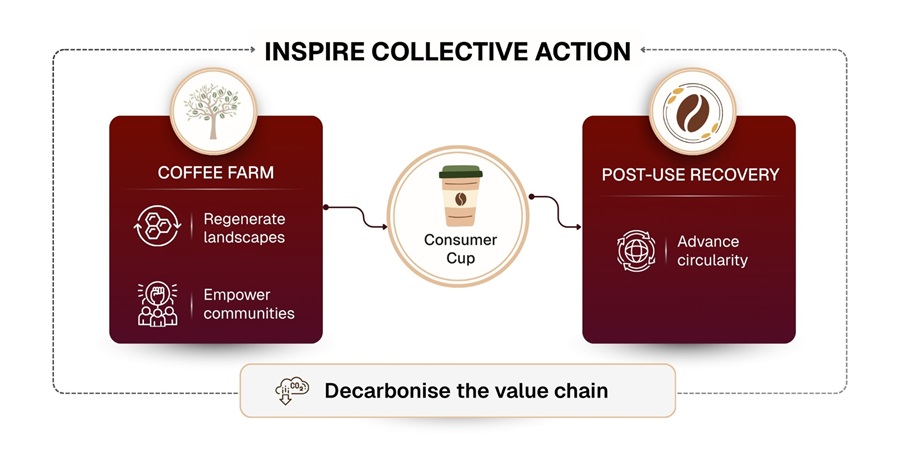
The strategic logic beneath the framework matters more than the framework itself. Nespresso sells a premium product, and that premium depends on consistently high-quality coffee drawn from a limited number of farms in climate-vulnerable growing regions. If those farms degrade or their soil loses fertility, and if growers abandon coffee for a more profitable crop, the product Nespresso sells ceases to exist in the form its customers pay for.
This is the structural insight that separates Nespresso's approach from conventional corporate sustainability. Protecting the farms functions as supply chain protection for an input the company cannot substitute, which places the work inside commercial strategy and outside philanthropy.
The company also holds B Corp certification, which requires independent verification of social and environmental performance across the whole business, extending well beyond any single department.
What ESG Initiatives Has Nespresso Implemented?
Nespresso's commitments carry specific numbers and dates, which makes them auditable against a published timeline. The company has set targets across environmental and social dimensions, each tied to a defined deadline. Several run through the AAA Sustainable Quality Program, its coffee sourcing network, and the emissions target is validated by the Science Based Targets initiative (SBTi), the body that assesses whether corporate climate goals align with the science.
|
Commitment
|
Target
|
Timeline
|
|
Net zero greenhouse gas emissions, aligned with the Science Based Targets initiative
|
Net zero across the value chain
|
2050
|
|
Regenerative agriculture across the AAA sourcing network
|
95% of AAA coffee from farms practicing regenerative agriculture
|
2030
|
|
Living Income Reference Price for smallholder farmers
|
All AAA smallholders across five sourcing countries
|
2030
|
|
Aluminium capsule recycling
|
60% global recycling rate
|
2030
|
|
B Corp recertification
|
B Impact score of 90 or above
|
2025, achieved
|
Nespresso created the AAA program in 2003 for a reason it states plainly. Arabica grows only at certain altitudes and demands an exacting balance of temperature and moisture, which makes it one of the crops most exposed to climate change.
The company judged that its long-term supply of high-quality coffee was under threat and built a sourcing program to protect it. The program has since grown from 300 farmers in Costa Rica to more than 150,000 across 18 countries.
That program is the operational engine behind the targets above, and Nespresso built it with the Rainforest Alliance. It embeds agronomists directly with farmers and provides technical training, paying a premium for coffee that meets its quality and sustainability standards.
Nespresso also buys from the same farmers year after year, which gives growers a reliable long-term buyer. Fairtrade and TechnoServe work alongside the company on the social and economic components.
The distinction worth noting is that the AAA program operates as working infrastructure. It employs people and runs on a budget, producing measurable results in the field. A target that lacks a delivery system of this kind remains an announcement without operational force behind it.
Why This Qualifies as a Business Model
The difference between a sustainability program and a sustainable business model comes down to a single question. Does the sustainability work produce commercial returns, or does it consume them?
A program operates as a cost center. It funds initiatives and publishes a report, managing reputational risk while the business would operate identically without it. A business model operates as a mechanism, where the sustainability work generates value that flows back into the commercial engine.
Nespresso's model produces returns through four channels.
-
Supply security. Regenerative agriculture protects soil health and yield resilience across the farms that supply the premium coffee Nespresso's product requires, which secures the input the entire business depends on.
-
Product differentiation. Traceable, verified, high-quality sourcing supports the price premium that Nespresso's positioning depends on. Customers pay more for coffee whose origin and standards are documented.
-
Farmer retention. Living income commitments keep growers producing coffee for Nespresso and discourage them from switching crops or selling to competing buyers, because the economics of the relationship favor continuity.
-
Regulatory positioning. B Corp certification and Science Based Targets alignment place the company ahead of tightening disclosure requirements, which reduces future compliance cost and exposure.
Each channel connects a sustainability activity to a commercial outcome. Withdraw one of them, and the company forfeits a specific commercial asset, whether that is supply security or the price premium its positioning requires. That connection makes the model durable, because the sustainability work now occupies the critical path of the business.
For a structured approach to building this kind of connection in your own organization, this roadmap for embedding sustainability in your core business strategy sets out the sequence from materiality assessment through to operational integration.
The Tensions Worth Acknowledging
A credible analysis of Nespresso's model has to address its central unresolved problem. The company sells coffee in single-use aluminium capsules, and no amount of upstream regenerative agriculture changes that format.
Aluminium is infinitely recyclable, which is the company's strongest defense. The 60% recycling target implies, by its own arithmetic, that 40% of capsules are expected to go unrecovered. Recovery also depends on consumer behavior and on local recycling infrastructure, neither of which Nespresso controls directly. It is acknowledged that portioned coffee carries structural waste that collection programs mitigate without eliminating.
This tension clarifies the strategy instead of invalidating it. Nespresso has built a rigorous sustainability model around the parts of its value chain where it holds genuine leverage, which is agricultural sourcing and farmer livelihoods, while managing the downstream waste problem its format creates without claiming to have solved it.
The strategic lesson is more significant than any verdict on the capsule. A credible sustainability model does not require a perfect product. It requires honest accounting of where the impact sits and how far the company's influence reaches. Companies that claim resolution on problems they have only mitigated lose credibility when the gap is exposed.
What Lessons Can Businesses Learn From Nespresso?
Few companies source coffee, and each depends on an input it cannot easily replace. That parallel makes the Nespresso case transferable, because the model draws its power from structure while the commodity remains incidental to it. Five lessons follow, and each addresses a specific point where sustainability programs detach from the business they are meant to serve.
-
Anchor sustainability to a material dependency. Identify the resource or relationship your business cannot operate without and concentrate on your sustainability investment there. Nespresso anchored its strategy to coffee farms, while your anchor might be water or a specific mineral, a supplier region or a skilled labor pool.
-
Attach numbers and dates to your commitments. Nespresso's targets carry percentages and years, which allows external parties to hold the company to them. A target that carries no date provides no basis for accountability.
-
Build the operating mechanism before announcing the goal. The AAA program employs agronomists and runs training, paying premiums for coffee that meets its standards. Commitments require infrastructure to deliver them, and that infrastructure needs a budget and staff, alongside accountable ownership.
-
Submit to external validation. B Corp certification and Science Based Targets alignment impose third-party discipline that internal reporting cannot supply. External standards limit an organization's capacity to assess its own performance without independent scrutiny.
-
Account honestly for what remains unsolved. Nespresso publishes its recycling rate instead of claiming circularity. Credibility comes from disclosing the gap, because an appearance of resolution invites the scrutiny that honest disclosure would have prevented.
Organizations routinely skip the first lesson. Sustainability investment scattered across unrelated initiatives produces reports instead of returns, because it never touches the commercial engine.
A parallel discipline appears in the analysis of how climate risk shapes decarbonization strategy, where mapping material exposure determines where strategic resources belong.
Where This Leaves Strategic Leaders
ESG disclosure is becoming mandatory across major markets, which shifts sustainability from a reputational choice into a strategic discipline backed by regulatory enforcement. The question facing leadership has moved past whether to report and now concerns whether the reported activity holds any structural relationship to how the business earns money.
That question demands a specific analytical skill. You need to distinguish a sustainability commitment that is load-bearing from one that is decorative, and the published report will not show you the difference. It appears instead in what would break if the commitment were withdrawn.
This kind of judgment is central to strategic analysis. The Senior Business Strategy Professional (SBSP™) certification develops the frameworks for testing how deeply an initiative is embedded in a business model, which is precisely the assessment that separates a durable sustainability strategy from an expensive one.
Conclusion
Nespresso's model works because sustainability is integral to how the company earns its margin. The company protects its farms because its product depends on them, and it pays its growers a living income because retention protects supply. It pursues external certification because tightening regulation makes verified performance an asset.
This does not imply that Nespresso has solved its waste problem, and the company's own targets acknowledge that it has not. The strategic insight holds regardless. A sustainability commitment survives budget pressure when the business would suffer from its removal, and it survives scrutiny when the company reports the gap between its ambition and its result. Leaders building a sustainable business model should start by asking which of their commitments would pass both tests.
Frequently Asked Questions
Q. Are Nespresso capsules recyclable?
A. Yes. The capsules are aluminum, which is infinitely recyclable, and Nespresso has committed to a 60% global recycling rate by 2030. That target implies the remaining 40% is not expected to be recovered.
Q. Is Nespresso a certified B Corp?
A. Yes. Nespresso holds B Corp certification and committed to recertifying with a B Impact score of 90 or above by 2025, which it achieved.
Q. What is the AAA Sustainable Quality Program?
A. It is Nespresso's coffee sourcing network, created in 2003 with the Rainforest Alliance. The program has grown from 300 farmers in Costa Rica to more than 150,000 across 18 countries.
Q. What separates a sustainability business model from a sustainability program?
A. A program consumes commercial resources and reports on them. A business model generates value that flows back into the commercial engine, which is what makes it durable under budget pressure.