Strategic Leadership Skills Every Functional Expert Needs for Senior Roles
 November 24, 2026
Functional managers build their careers by becoming experts in their areas. They understand their teams, improve processes, solve operational problems, and deliver results. These abilities help them earn trust and progress into management roles.
However, moving into senior leadership requires a broader perspective. A functional manager focuses mainly on departmental performance, while a strategic leader considers how different functions contribute to business goals, how decisions affect the organization, and where resources should be directed.
This transition requires more than taking on additional responsibilities. Managers must learn to connect departmental priorities with business outcomes, influence people beyond their reporting lines, and make decisions when information is incomplete.
In his Harvard Business Review article, How Managers Become Leaders, Michael D. Watkins describes several shifts involved in this transition, including moving from specialist to generalist, analyst to integrator, tactician to strategist, and problem solver to agenda setter.
Here are the key capabilities functional managers need to develop to prepare for strategic leadership.
Why High-Performing Managers Struggle to Move Into Senior Leadership
A manager who consistently delivers results within one department may still struggle when given responsibility for a larger part of the business. The skills that make someone successful in a functional role do not always prepare them for enterprise-wide leadership.
For example, a marketing manager may focus on campaign performance, lead generation, and customer acquisition. A strategic leader must also consider how marketing decisions affect sales, customer retention, product development, and profitability.
Watkins describes this transition as shifting from managing a function to leading an enterprise. Leaders must integrate information from different areas, identify broader priorities, and bring people together around shared goals.
The need for these capabilities is reflected in DDI’s Global Leadership Forecast 2025. Based on responses from 10,796 leaders and 2,185 human resources (HR) professionals across 2,014 organizations, the report found that 83% of HR organizations predicted increased demand for new leadership capabilities over the following five years. However, only 22% prioritized developing future-focused skills, including setting strategy, managing change, making decisions, and developing future talent.
This gap shows why functional expertise alone does not sufficiently prepare managers for senior responsibilities. They also need opportunities to develop skills that help them guide the wider business.
Functional Manager vs. Strategic Leader
| Area |
Functional Manager |
Strategic Leader |
| Primary focus |
Departmental performance |
Organization-wide results |
| Decision-making |
Resolves operational issues |
Evaluates long-term implications |
| Planning |
Sets departmental goals |
Connects plans with business strategy |
| Collaboration |
Works mainly within the department |
Coordinates across functions |
| Resource allocation |
Manages departmental resources |
Weighs needs across the organization |
| Leadership approach |
Guides team execution |
Develops people and sets direction |
Understand How Different Business Functions Work Together
Strategic leaders look beyond departmental targets. Every function contributes to business performance, and decisions in one area can affect several others.
For example, reducing operating costs may improve short-term financial results but create additional pressure on customer service. A product launch may increase sales opportunities while placing greater demands on technology, supply chains, and support teams.
Deloitte’s 2024 Global Human Capital Trends research found that 81% of executives said work was increasingly performed across functional boundaries. Another 54% said cross-functional collaboration at the worker level happened often or all the time.
Functional managers preparing for senior roles should understand how other teams operate and what they need to succeed. They can build this perspective by:
-
Learning how other departments contribute to business performance.
-
Participating in projects involving multiple functions.
-
Understanding the priorities and challenges of other teams.
-
Asking colleagues how departmental decisions affect their work.
-
Considering wider business implications before recommending changes.
Deloitte’s 2026 Global Human Capital Trends report adds another reason to develop this perspective. Seven in 10 business leaders said their primary competitive strategy over the next three years was to be fast and nimble, adapting to changing business, customer, or market needs.
Leaders who understand how departments depend on one another can coordinate resources and help teams respond when priorities change.
Use Financial Knowledge to Evaluate Business Decisions
Strategic leaders need to understand how business decisions affect financial performance. They do not have to become finance specialists, but they should be comfortable interpreting financial information and evaluating proposals.
A recommendation to hire employees, invest in software, expand a service, or change a process has financial implications. Senior leaders must understand the expected costs, potential returns, risks, and effect on available resources.
Managers should develop familiarity with:
-
Understanding profit and loss (P&L) statements to assess revenue, operating expenses, and profitability.
-
Reading balance sheets to understand assets, liabilities, and the organization’s financial position.
-
Interpreting cash flow statements to track money moving into and out of the business.
-
Evaluating return on investment (ROI) to determine whether expected benefits justify an investment’s cost.
-
Reviewing budgets and forecasts to understand planned spending and estimated financial performance.
This knowledge becomes useful when managers apply it to actual business decisions. Instead of recommending a project simply because it improves departmental efficiency, explain how it could reduce costs, increase revenue, or improve customer retention.
Deloitte’s report provides an example from technology investment. 59% of surveyed C-suite leaders said their organizations took a technology-focused approach to artificial intelligence (AI). Organizations taking this approach were 1.6 times more likely not to achieve AI investment returns surpassing initial projections than those taking a human-centric approach.
Although this finding relates specifically to AI investment, it highlights the importance of evaluating proposals beyond their immediate technical or operational benefits. Leaders must consider how investments support people, processes, and business outcomes.
Learn to Influence and Align Teams Across Departments
Functional managers generally work with teams over which they have direct authority. Strategic leaders must also coordinate with people in other departments who report to different managers.
For example, a technology leader proposing a new customer data system may need support from finance, marketing, legal, and operations. Each department will have different concerns. Finance may focus on cost, legal teams on compliance, and marketing on customer insights.
The leader must understand these priorities and explain how the proposal supports shared business goals.
Influence develops through trust, communication, and an understanding of other people’s priorities. Managers can strengthen it by:
-
Building relationships with peers before seeking their support.
-
Understanding other departments’ constraints.
-
Explaining proposals in terms of shared outcomes.
-
Listening to concerns and considering different viewpoints.
-
Following through on commitments.
These practices help leaders build cooperation, resolve disagreements, and move cross-functional initiatives forward without relying on formal authority.
Move From Managing Tasks to Developing People
Many managers earn recognition because they are reliable problem solvers. They understand the details of their function and can step in when something goes wrong.
However, this approach can become a limitation at the next leadership level. If managers handle every important task, approve every small decision, or solve every team problem, they have little time for broader responsibilities.
Strategic leadership requires a shift from doing the work to enabling others to do it well. Managers need to delegate responsibility, develop team members, and allow people to make decisions within clear boundaries.
The transition can be difficult, particularly for managers who have built their reputation on personal performance. They may worry that work will not meet their standards or that delegating important tasks will reduce their control.
Research from the Center for Creative Leadership (CCL) highlights some challenges associated with transitioning into management. Its research paper on first-time managers found that 26% of first-time managers felt unprepared to lead others, while almost 60% said they received no training when they transitioned into their first leadership role. The paper also reported that 20% were rated as doing a poor job by their subordinates.
These findings concern first-time managers, not specifically functional managers moving into enterprise-wide leadership. However, they highlight the importance of preparing people for new management responsibilities.
Managers can start by assigning decisions that team members are ready to own, providing guidance when needed, and reviewing outcomes rather than controlling every step. This builds team capability and creates more time for strategic work.
Make Strategic Decisions With Incomplete Information
Functional managers often work with established processes, defined targets, and information specific to their departments. Strategic leaders face broader decisions involving uncertainty, competing priorities, and incomplete information.
A company may need to decide whether to enter a new market, invest in a technology platform, restructure a department, or change its operating model. The available information may not provide a clear answer, but waiting for complete certainty can mean missing an opportunity.
Strategic leaders evaluate available information, identify risks, consider alternatives, and make decisions within a reasonable timeframe. They also recognize which assumptions need testing and what risks the organization can manage.
A practical approach includes:
-
Define the decision: Identify the problem and the outcome the organization needs.
-
Gather information: Consult people with different expertise and review available data.
-
Identify assumptions: Separate confirmed information from estimates.
-
Evaluate alternatives: Consider costs, benefits, risks, and business implications.
-
Make the decision: Choose a direction and communicate the reasoning.
-
Review the outcome: Track results and adjust when new information becomes available.
Deloitte’s 2025 Global Human Capital Trends research found that high-performing organizations were 22 times more likely to openly discuss how decisions are made, nine times more likely to teach decision-making skills, and seven times more likely to provide tools that support high-quality decisions than low-performing organizations.
These findings reinforce the importance of making decision-making practices transparent and helping teams develop the skills to evaluate choices.
How to Prepare for a Strategic Leadership Role
Managers do not need to wait for a promotion to develop strategic leadership capabilities. They can build experience through their current responsibilities and by taking on work that exposes them to broader business challenges.
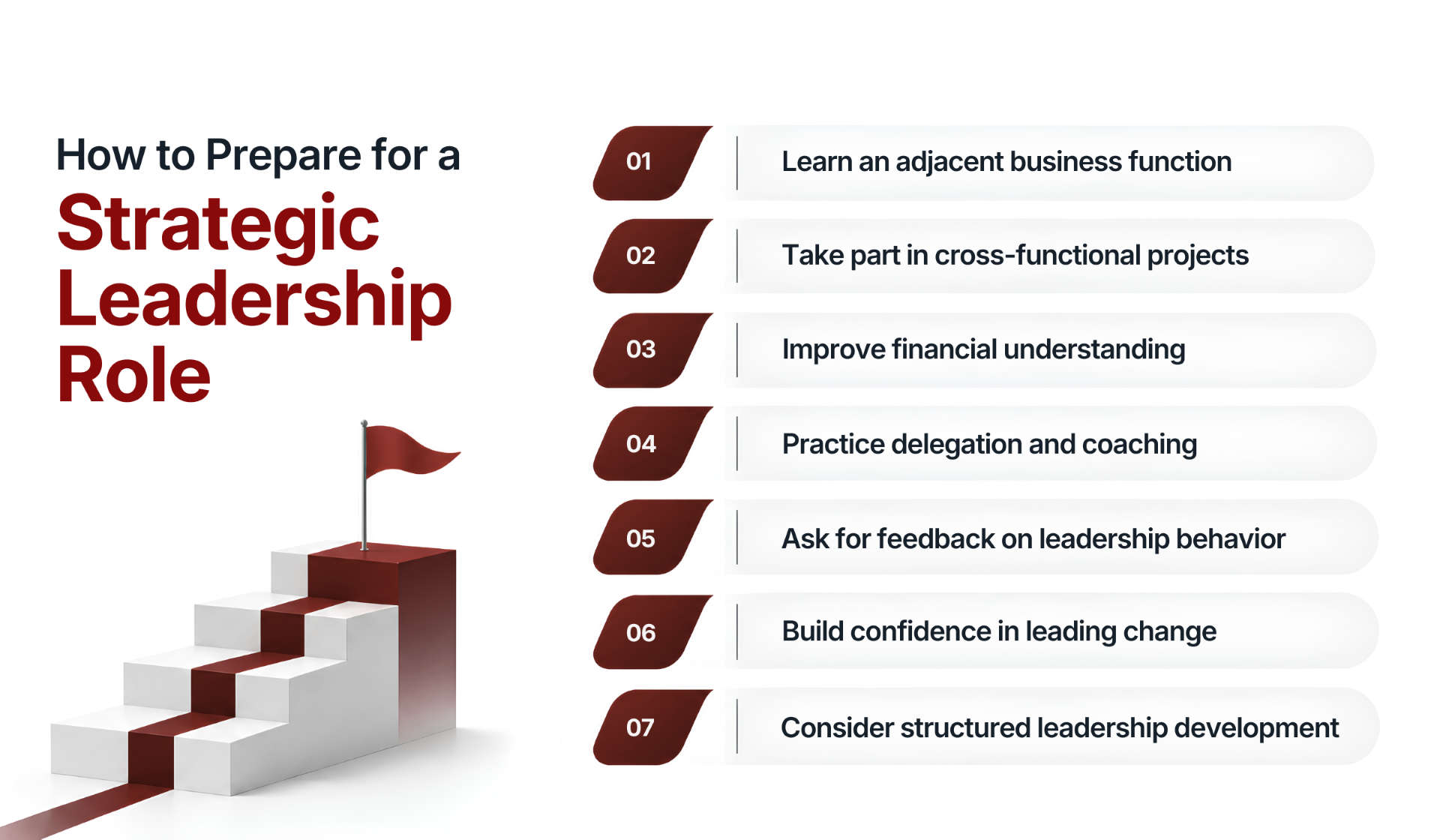
A practical development plan includes:
1. Learn an adjacent business function
Choose a department that regularly works with your team. Understand its goals, performance measures, budget considerations, and challenges.
2. Take part in cross-functional projects
Volunteer for initiatives involving multiple departments. These projects help you coordinate priorities and manage competing expectations.
3. Improve financial understanding
Review business reports, budgets, and forecasts. Ask finance colleagues to explain unfamiliar measures and how departmental performance connects with revenue and costs.
4. Practice delegation and coaching
Give team members ownership of appropriate tasks and decisions. Set clear expectations, provide guidance, and let them take responsibility for results.
5. Ask for feedback on leadership behavior
Seek feedback from managers, peers, and team members. Ask whether you communicate priorities clearly, consider wider business needs, and involve the right people in decisions.
6. Build confidence in leading change
DDI’s Global Leadership Forecast 2027 found that only 17% of leaders felt confident anticipating and reacting to the nature and speed of change. Organizations with effective change leadership were 2.4 times more likely to meet or exceed their financial targets.
Managers can develop this capability by leading smaller changes, explaining why they are needed, listening to employee concerns, and tracking results.
7. Consider structured leadership development
Executive education, leadership development programs, and mentoring can help managers strengthen strategic thinking, financial understanding, communication, and decision-making. Choose programs that address actual development needs rather than relying only on credentials.
Conclusion
The transition from functional manager to strategic leader involves shifting from managing departmental performance to guiding broader business outcomes. Functional expertise remains important, but senior roles demand financial understanding, cross-functional influence, sound decision-making, and the ability to develop others.
Managers can begin this transition before receiving a senior title. By taking on cross-functional projects, learning how other departments operate, and giving their teams greater responsibility, they can build the perspective needed to lead beyond their area of expertise.