Agentic AI Strategy: How to Build a Business Model Around Agents
 November 05, 2026
Nearly nine in ten organizations report regular use of AI in at least one business function. Yet only a third can attribute any impact on earnings before interest and taxes (EBIT) to that use.
Those figures come from McKinsey’s 2026 global AI survey of 1,719 respondents across 97 nations. The same survey found that six percent qualify as high performers, attributing at least 5 percent of EBIT to their AI use. Nearly three-quarters of that six percent had redesigned their workflows around AI. Among all other respondents, a quarter had.
That gap is the premise of this article. Agentic AI makes redesign more consequential, since an agent inherits the structure of whatever workflow you place it in.
What is An Agentic AI Strategy?
An agentic AI strategy defines where an organization will delegate execution to AI agents, what outcomes those agents are responsible for, where human intervention remains necessary, and how the resulting workflows will be measured and governed.
What Separates Agent-Enabled Workflows From AI-Assisted Work
Redesigning a workflow for an agent requires a precise account of what the agent changes. Both models below run on the same underlying technology, and they differ in where the work stops and who answers for the result.
AI-assisted work is an operating model in which an AI system produces output for a person to evaluate, and the person performs the action that completes the task. The system returns a single artifact, which might be a draft or a ranked list.
Nothing reaches a customer or a record until that person acts, the workflow remains constrained by the human capacity required to review and complete the work.
An agent-enabled workflow is an operating model in which an AI system receives a goal and the authority to pursue it across multiple steps. It determines its steps and interacts with external systems until a defined exit condition is met.
The work ends with a completed transaction or a resolved case. A person sets the goal and the boundaries, then handles the exceptions.
Consider a single recruiting task handled both ways. Under the assisted model, an AI assistant summarizes 200 applications, and your recruiter decides whom to interview. Under the agent-enabled model, the workflow screens each application against the role criteria and schedules the interview itself. Underlying technology is comparable in each case.
Autonomy in the agent-enabled case is always bounded. You set the ceiling on what the system may commit and the threshold at which it must escalate, and that decision governs your exposure. Tightening the ceiling returns throughput to human capacity, and loosening it enlarges what a single error can reach.
The accountability shift is what reshapes your business model. A person intercepts a weak draft before it reaches a customer. An agent that finishes a task incorrectly has already acted, so your review function now sits after the event.
| Dimension |
AI-Assisted Work |
Agent-Enabled Workflow |
| Definition |
The system produces output for a person to act on |
The system pursues a goal and completes the work |
| What it delivers |
A draft, summary, or ranked list |
A completed transaction or resolved case |
| Who finishes the work |
Your employee |
The system |
| Where the person sits |
Reviewing each output |
Setting boundaries and handling exceptions |
| What limits throughput |
Reviewer capacity |
Compute cost and the escalation rate |
| What you can charge for |
Time saved per employee |
The outcome itself |
| What a failure produces |
A flawed draft someone intercepts |
An action already taken |
Read the last row alongside the sixth. The ability to charge for an outcome and the exposure to an uncaught error arrive together, since both follow from the system finishing work a person used to finish.
Adoption concentrates among larger organizations, with McKinsey finding 40 percent of those above USD 1 billion in revenue scaling AI agents, up from 27 percent a year earlier. Roughly two in ten report scaling coding agents, which work with a measurable output.A separate guide to using large language models (LLMs) in business covers the assisted model and how to measure what it returns.
Where Agent-Enabled Value Comes From
The value from agentic AI arises in three specific ways:
-
Your cost structure can become less directly tied to headcount. In an assisted model, output is constrained by the human capacity required to review and complete work. In an agent-enabled process, some of that capacity can shift toward compute and exception handling.
-
Cycle time compresses, which changes what you can promise. A workflow that ran overnight to accommodate a review step can finish in minutes. Customers pay for a shorter service commitment, and that commitment becomes credible once review is removed from the delivery path.
-
Your unit of sale can move from effort to outcome. Once you control execution end to end, you can price the resolved case or the completed claim. An hourly rate describes an input, and a buyer can compare inputs across your competitors.
Each mechanism depends on the redesign that McKinsey’s data identifies. An agent placed inside an existing workflow still waits for the handoffs that workflow contains, and the cost curve stays attached to headcount because your reviewers remain in position. Redesign is where the return comes from, and the agent is what makes redesign worth the disruption.
How to Build a Business Model Around Autonomous Execution
The sequence below turns that redesign into a priced offering. Take the steps in order, since each sets a constraint for the next.
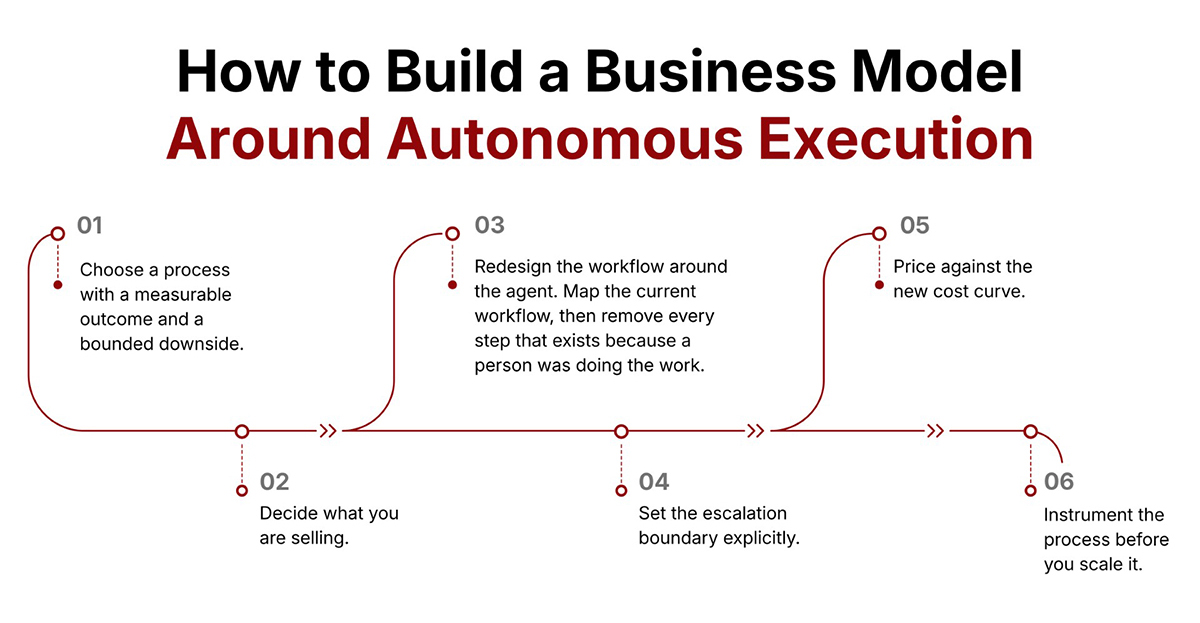
Step 1: Choose a process with a measurable outcome and a bounded downside. You must define a correct result and tolerate a bounded error. A refund below a set value clears both tests. A credit decision on a commercial loan clears the first and fails the second.
Step 2: Decide what you are selling. Capacity and outcomes are separate businesses, with their own margins and their own contract structures. Settle this question before you design anything, because the answer determines what you measure and what you guarantee to a customer.
Step 3: Redesign the workflow around the agent. Map the current workflow, then remove every step that exists because a person was doing the work. Batch windows and handoff approvals are the usual candidates. What remains is the workflow your agent should run.
Step 4: Set the escalation boundary explicitly. Write down what the agent may decide alone and what it must route to a person. Name the value or confidence threshold that separates the two. This boundary becomes a core risk control, and Step 6 depends on the organization being able to measure how often the agent crosses it.
Step 5: Price against the new cost curve. Calculate your cost per completed outcome, counting compute alongside the exception queue and the audit function it needs. Price from that figure, since teams that price from the old cost base give the entire gain to the customer.
Step 6: Instrument the process before you scale it. Four numbers tell you whether it is ready:
- Escalation rate
- Error rate on completed work
- Cost per completed outcome
- Time to resolution
Run it at low volume, until those numbers hold steady across a full business cycle. Expect the escalation rate to move once volume changes the mix of cases arriving.
Steps 3 and 4 are the demanding ones. They are also the two that teams under delivery pressure compress, which is how an agent comes to run an unchanged process with an undefined boundary.
What Changes in the Operating Model
Four structural changes follow from autonomous execution, and each needs a named owner before you launch.
Accountability for unattended outcomes. Someone has to own a result that no person reviewed. That means naming a process owner who holds the error rate as a target and carries the authority to pause the agent. An operating model that leaves this unassigned discovers the gap during an incident.
Quality control moves from approval to audit. Your reviewers stop checking every output and begin checking samples and exceptions. Those are separate skills and a separate job description. The review function shrinks in headcount and rises in seniority, because judgment on a difficult exception is harder work than approval of a routine draft.
Capacity planning changes units. Forecasting in full-time equivalents stops describing your capacity. You plan in compute budget and escalation volume, with audit coverage sized against both. Finance needs these units early, since a budget built on the old ones misprices the program from its first quarter.
Governance varies by autonomy level. Gartner sorts agents into four autonomy levels and assigns separate controls to each. The lowest level is read-only observation, and the highest is acting without human approval. A read-only agent needs scoped data access and usage logging. An agent acting on its own needs continuous monitoring alongside enforced guardrails and a rollback path. One standard applied across both leaves the gaps that surface after a production incident.
These changes belong to a broader discipline. This step-by-step automation strategy framework covers the workflow audits and ownership decisions that any autonomous program depends on.
The Strategic Trade-Offs
Gartner expects more than 40 percent of agentic AI projects to be canceled by the end of 2027. It names three causes, and each is a strategic decision you can make deliberately.
| Gartner’s Stated Cause |
How it Appears in Practice |
The Decision that Reduces the Risk |
| Escalating costs |
Per-task compute cost climbs with retries and long tool chains |
Set a cost ceiling per outcome at design time and measure against it weekly |
| Unclear business value |
The program reports activity volumes with no financial line attached |
Name the profit-and-loss line the program moves, and give that line an owner |
| Inadequate risk controls |
The escalation boundary lives in conversation and never in configuration |
Write the boundary as code and test it before the agent touches live work |
Two further trade-offs fall outside those three causes.
Vendor claims need verification. Gartner estimates that roughly 130 of the thousands of vendors describing their products as agentic are genuine, with the remainder rebranding existing assistants and robotic process automation tools. Ask any vendor which decisions its system makes without a human, then ask to see the escalation configuration. A product that cannot show you one is an assistant in new packaging.
Autonomous processes are harder to reverse. An assisted process survives a withdrawn tool, because your people still know how to do the work themselves. An agent-enabled process erodes that fallback. The staff who ran the manual version are redeployed, and the working knowledge they held is gone.
That argues for careful sequencing over breadth of deployment. This analysis of how to build strategic optionality into your business strategy sets out how to hold a reversible position while you commit resources.
Gartner also expects 15 percent of day-to-day work decisions to be made autonomously by 2028, up from none in 2024. In that market, waiting carries a cost alongside the cost of moving early.
Conclusion
Two Gartner projections describe the position you are in. More than four in ten agentic AI projects will be canceled by the end of 2027, and 15 percent of day-to-day work decisions will be made autonomously by 2028. Both projections can hold at the same time. Autonomous execution becomes a standard capability, and a large share of the programs built to reach it are abandoned first.
The capability itself reaches every competitor on the same commercial terms. What distinguishes you is the workflow you rebuilt around it, priced as a completed outcome and bounded by a rule you can defend to a regulator. That is what separated McKinsey’s six percent from everyone else in its sample.
Pick one process this quarter and rebuild it around the agent, then price the completed outcome against your new cost curve. A single workflow run this way teaches you more about your operating model than a portfolio of pilots that never leave the assisted model.