How Middle Managers Bridge Strategy and Execution During Organizational Change
 December 24, 2025
When organizations undergo strategic transformation, attention typically centers on senior executives who shape the vision and frontline teams who bring it to life. However, there's a critical group often overlooked in this equation: middle managers. These leaders occupy a unique position between strategic planning and daily operations, making them essential catalysts for successful organizational transformation.
The reality is that strategic plans created in boardrooms often fail not because of poor vision, but because of poor execution. Middle managers hold the key to bridging this execution gap. They understand both the strategic imperatives from above and the operational constraints below, positioning them perfectly to translate abstract goals into concrete actions that teams can rally behind.
The Strategic Position of Middle Managers
Middle managers serve as the vital bridge connecting high-level business strategy with ground-level execution. Unlike senior leaders who focus on long-term vision or frontline workers who handle specific tasks, middle managers translate abstract strategic goals into concrete actions their teams can understand and implement.
Consider their unique vantage point: they sit close enough to leadership to understand strategic rationale yet remain connected enough to daily operations to grasp practical constraints. This dual perspective enables them to spot potential implementation challenges before they derail initiatives and identify opportunities that executives might miss from their distance.
A striking example comes from Funabashiya Research, a 200-year-old Japanese confectionery firm. When the CEO’s son drove aggressive modernization and his father fought to protect centuries-old traditions, the management layer in between became the true architects of change. Over two decades, these leaders patiently built bridges, found compromises, and ultimately guided the company toward a future that preserved its soul while securing its survival.
The Three Phases of Manager-Led Transformation
Research identified three distinct stages through which middle managers facilitate organizational change:
Phase 1: From Resistance to Realization
The Initial Division
When change begins, managers split into camps:
-
"Custodians" want to preserve traditional methods and values
-
"Prospectors" push for innovation and new approaches
-
The division often seems insurmountable
The Critical Realization
Over time, resistant managers experience a shift in thinking:
-
They realize protecting what they value requires adaptation
-
Without change, the organization might not survive to preserve any traditions
-
Long-term survival demands evolution
The Personal Transformation
This phase involves reconciling:
-
Attachments to the past
-
Recognition that the future demands adaptation
-
Understanding that protecting the past requires adapting for the future
Reality: While some custodians leave the firm, others gradually change their minds and become prospectors.
Example from Funabashiya: Custodians initially resisted standardization of craft production. Over time, some recognized that without modernization, the company wouldn't survive to preserve any traditions.
Phase 2: Temporal Socialization
Once some custodians become supporters, they leverage:
-
Their credibility with resistant peers
-
Existing trusted relationships
-
Authentic understanding of both perspectives
How Change Spreads
Converted managers become "middlemen trying to bridge the gap" between polarizing viewpoints:
-
They facilitate change through relationships, not mandates
-
Their conversion stories carry weight that executive directives never could
-
They've walked the same journey as resistant colleagues
Why This Works
Change spreads through social networks rather than formal hierarchies:
-
Respected peers champion new approaches
-
Others become more willing to experiment
-
Positive peer influence replaces coercive management pressure
Example from Funabashiya: Newly converted prospectors created a more cheerful atmosphere in the firm, using their ability to understand both perspectives to persuade others authentically.
Phase 3: Coalescing the Past
The Synthesis
A shared understanding emerges:
-
New strategies can actually preserve core values better than outdated methods
-
Innovation and tradition aren't enemies, they're partners
-
Apparent contradictions resolve into synthesis
The Breakthrough Insight
Organizations discover how to:
-
Honor heritage while embracing innovation
-
Create a path forward that feels authentic, not compromised
-
Preserve what matters most through strategic evolution
Example from Funabashiya:
The Problem: Traditional mixing relied purely on intuition. As one employee noted: "We did not know exactly how we mixed the three types of starch."
The Solution: Custodians recognized that standardization could better protect quality and tradition than relying solely on intuition.
The Realization: Standardization didn't eliminate craft, it codified and preserved it.
The Timeline: This gradual understanding led to more universal acceptance of changes over the 20-year transformation period.
Common Challenges Middle Managers Face
Despite their importance, middle managers encounter significant obstacles when implementing change strategies. Understanding these challenges helps organizations provide better support:
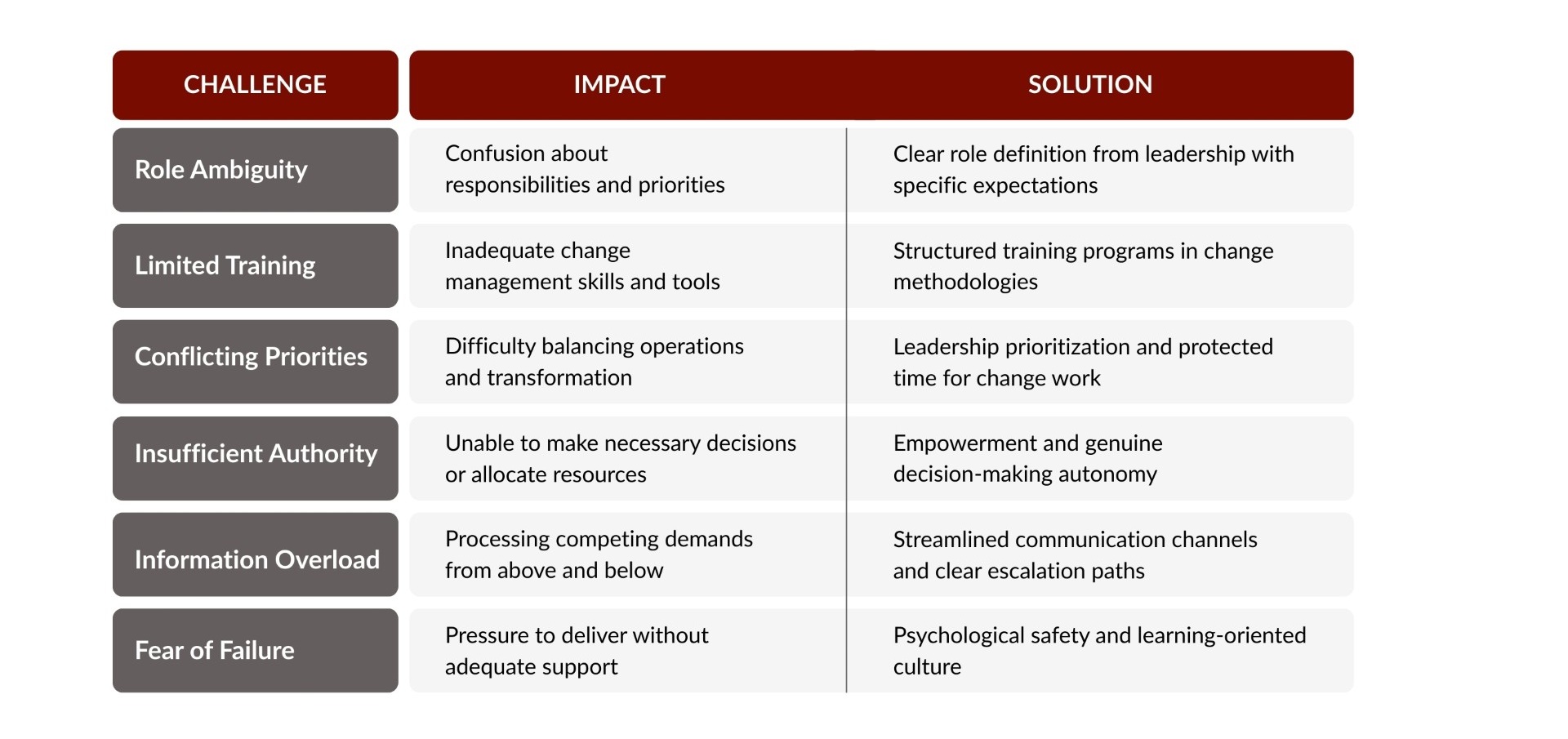
Organizations often assume middle managers will naturally support change without clearly defining their responsibilities, creating unnecessary confusion and reduced effectiveness. This assumption ignores that change of leadership requires distinct skills beyond operational management.
Without clear direction from senior leadership, managers may focus on maintaining status quo operations rather than proactively driving change. They become order-takers rather than strategic contributors, undermining both their effectiveness and their engagement with transformation initiatives.
How Organizations Can Empower Middle Managers?
Middle managers are the bridge between strategy and execution, yet they’re often left unsupported during change. This section shows how clear roles, targeted training, strong leadership backing, open feedback, and real recognition turn middle managers into powerful drivers of transformation.

1. Provide Clear Direction and Role Definition
Why It Matters: When middle managers understand exactly what's expected, they can focus energy on execution rather than interpretation.
What Organizations Should Define:
-
Communicating updates to teams
-
Addressing resistance constructively
-
Fostering employee engagement
-
Monitoring adoption progress
-
Decision rights: What can they decide independently vs. what requires escalation?
The Impact: Clear boundaries prevent both the paralysis of seeking approval for minor decisions and the chaos of making major decisions without proper authority.
2. Invest in Change Management Training
The Reality: Many organizations send middle managers into change initiatives armed only with operational management skills, wondering why transformation struggles.
Essential Training Topics:
-
Communication techniques for explaining change effectively
-
Resistance management strategies that work
-
Coaching methods for supporting employees through transitions
-
Change management frameworks and methodologies
What This Signals: Organizations value middle managers' contributions and recognize the complexity of their role.
3. Ensure Leadership Alignment and Support
What Senior Leaders Must Do:
-
Actively support and empower middle managers (not just treat them as implementers)
-
Provide direct access to decision-makers for guidance and issue resolution
-
Engage seriously when managers raise implementation concerns
Critical Insight: Middle managers often spot practical problems that executives miss from their strategic distance. Treat these insights as valuable intelligence, not negativity.
The Result: Better strategy quality + stronger middle manager engagement
4. Create Feedback Channels
Enable Two-Way Communication:
Upward (Middle Managers → Leadership):
-
Implementation challenges
-
Frontline insights
-
Resource needs
-
Employee concerns
Downward (Leadership → Middle Managers):
-
Strategic rationale
-
Flexibility boundaries
-
Decision-making clarity
-
Change updates
Methods That Work:
-
Regular surveys
-
Focus groups
-
One-on-one meetings
-
Skip-level conversations
Why It Matters: Prevents the "telephone game" where messages distort passing through organizational layers.
5. Recognize and Reward Change Leadership
Celebrate small wins and early adopters to maintain momentum during difficult middle phases.
Recognition Methods:
-
Performance evaluations that include change leadership
-
Public acknowledgment programs
-
Career development opportunities
-
Tangible rewards for transformation success
What This Signals: Change leadership enhances rather than hinders career progression.
The Multiplier Effect: When others see change leaders rewarded, they're encouraged to embrace similar behaviors.
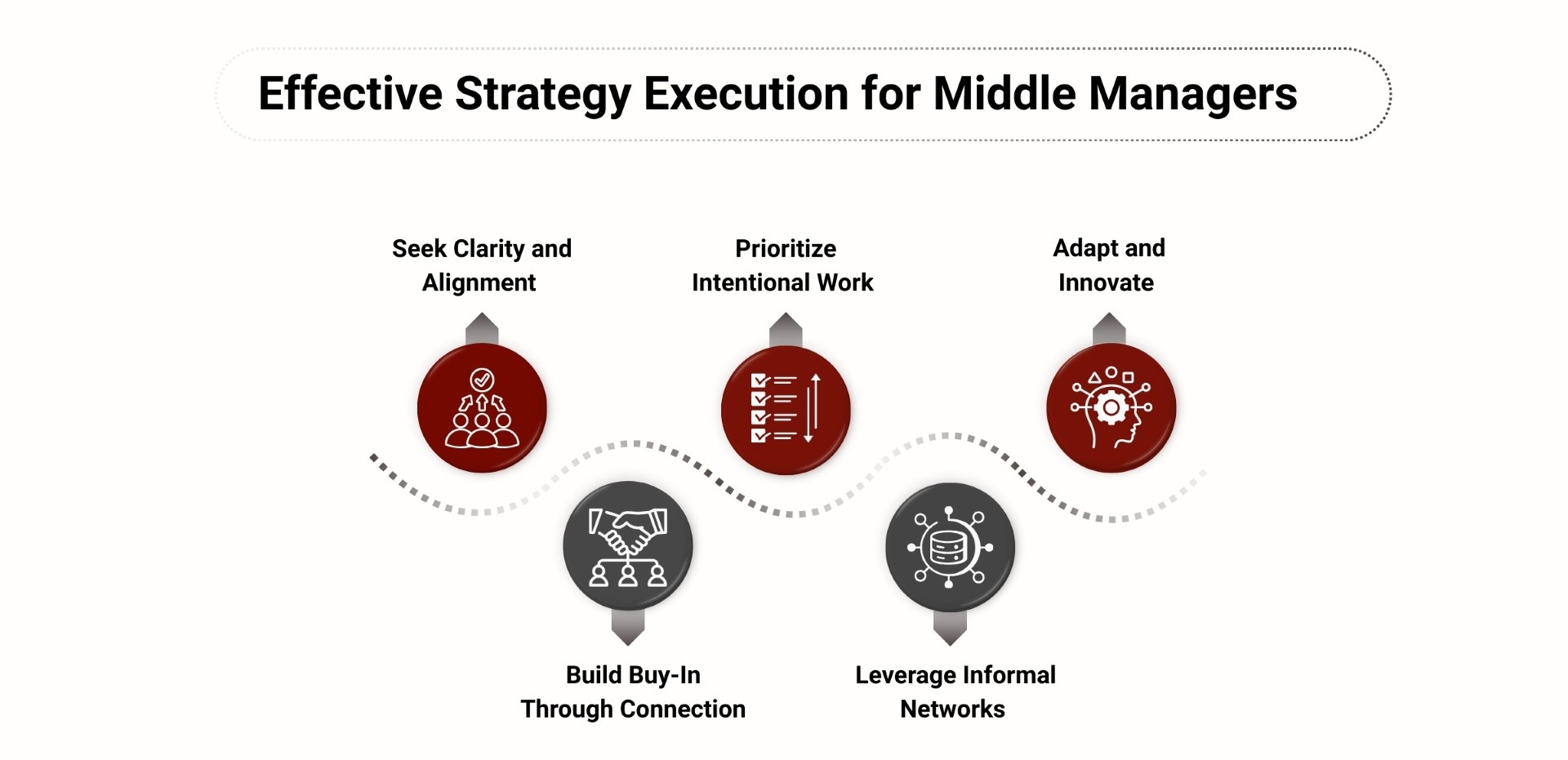
Effective Strategy Execution for Middle Managers
Middle managers themselves can take proactive steps to drive successful strategy changes, even when they didn't create the strategy:
1. Seek Clarity and Alignment
Before implementing any change, middle managers should ask questions to understand strategic objectives fully. Questions might include: What problem does this strategy solve? How will we measure success? What constraints or non-negotiables exist? Where do I have flexibility to adapt?
Identify gaps between strategic intent and operational realities, then advocate for adjustments that improve feasibility. Executives often lack detailed knowledge of implementation constraints. Middle managers who surface these issues constructively help refine strategies before costly failures occur.
2. Build Buy-In Through Connection
Translate corporate directives into relatable team goals by explaining how abstract strategies affect specific roles. Instead of announcing "we're implementing digital transformation," explain "we're adopting new software that will eliminate the manual data entry that frustrates you daily."
Engage employees in discussions about personal impact, helping them see benefits rather than only burdens. People resist change less when they understand "what's in it for me." Celebrate progress milestones to maintain momentum, recognizing both team and individual contributions to build positive associations with transformation.
3. Prioritize Intentional Work
Middle managers face constant pressure from multiple directions. To avoid overwhelm, set boundaries to avoid spreading too thin. This might mean declining some requests or negotiating deadlines to balance competing priorities.
Delegate tasks not requiring unique expertise, freeing capacity for high-value activities only you can perform. Reserve time for strategic thinking and reflection rather than operating in constant reactive mode. Change leadership requires proactive planning that urgent operational matters often crowd out.
4. Leverage Informal Networks
Build coalitions supporting strategic initiatives by identifying influential employees and securing their buy-in early. These informal leaders often hold more sway over peer opinions than formal authority figures.
Share insights across departments to identify synergies and prevent duplicated efforts. Advocate for necessary resources by translating needs into business terms leadership understands. Frame requests around strategic value rather than merely operational convenience.
5. Adapt and Innovate
Monitor progress regularly using key performance indicators and adjust plans as needed based on results and feedback. Encourage team members to propose creative solutions for overcoming obstacles. People closest to problems often see solutions that distant planners miss.
Embrace a learning mindset by reflecting on both failures and successes. What worked? What didn't? Why? This continuous improvement approach prevents repeating mistakes while scaling successes.
Conclusion
Middle managers aren't simply intermediaries passing messages between executives and employees. They're essential architects of organizational change, translating business strategy into reality through relationship-building, conflict mediation, adaptive leadership, and persistent execution.
When team leads, department heads, and unit managers aren’t fully on board, even the most brilliant strategy stalls. People resist, adoption falters, and momentum dies long before the finish line.
The companies that actually transform don’t win because of perfect slides from the C-suite. They win because their frontline leaders, supervisors, and group managers make the new direction feel possible, one team, one meeting, one decision at a time.
Give these leaders clear direction, real authority, proper training, and genuine recognition, and something powerful happens in abstract goals become reality.
Organizations that finally see this truth stop treating the middle as a relay station and start treating it as the engine room.
That single shift is what separates strategies that sound good on paper from strategies that change everything.