What Is Ethical Leadership? Traits, Real-World Examples, Challenges and Why It Matters
 May 05, 2026
Leadership has always been tested by the decisions made when the right path is inconvenient. What has changed now is the scope and speed of those tests. Leaders today navigate AI-driven workplaces, increasingly diverse teams, real-time public scrutiny, and pressure to deliver results without compromising the values their organizations claim to hold. In that context, ethical leadership has moved from being a desirable quality to a functional requirement. This guide breaks down what ethical leadership actually means in practice, the principles that underpin it, the dilemmas leaders regularly face, and the trends shaping how corporate ethics is being defined and measured right now.
What Is Ethical Leadership?
Ethical leadership is the practice of making professional decisions that are grounded in moral principles, not just business outcomes. It means leading by example, being transparent about reasoning, treating people with fairness and dignity, and taking responsibility when things go wrong.
This kind of leadership shows up in how a manager handles a promotion decision, how a senior leader responds to internal misconduct, and whether employees feel safe raising concerns without fear of retaliation. The standard an ethical leader sets ripples outward through every team interaction, every client relationship, and every public-facing decision the organization makes.
Corporate ethics and values-driven leadership are not soft ideals. They are operational realities that shape how much an organization can trust itself to function well under pressure.
Why Ethical Leadership Matters More Than Ever
own considerably. Organizations now operate under greater public scrutiny, face more diverse workforces with higher expectations of fairness, and are navigating technologies that raise new questions about accountability and bias. Leaders who fail to meet these demands create reputational and financial exposure for their organizations.
The trust deficit at the leadership level is real and measurable. Only 21% of employees strongly agree that they trust the leadership of their organization, according to a Gallup study. When trust is that low, the downstream effects are predictable: disengagement, higher attrition, reluctance to speak up about problems, and a culture that tolerates rather than corrects poor behavior.
Contrast that with organizations where ethical leadership is consistent and visible. Employees who feel genuinely cared for are 69% less likely to actively search for a new job. That kind of retention stems from how people are treated and how deeply they feel seen by their managers, far more than from compensation packages or perks.
Beyond retention, ethical business practices directly affect brand reputation. Consumers increasingly make decisions based on how companies behave, not just what they sell, and how a company’s leaders act internally tends to surface publicly over time.
An Ethical Decision-Making Framework for Leaders
Ethical leadership does not mean every decision is easy or obvious. What it means is that leaders approach difficult decisions with a consistent set of principles rather than defaulting to convenience or expediency. A practical framework involves five considerations that can be applied across a wide range of situations.
-
1. Transparency: can you explain the reasoning behind this decision openly to the people it affects? If the answer requires significant concealment, that is a signal worth examining.
-
2. Fairness: are all affected parties being treated consistently, and is the decision based on relevant criteria rather than personal preference?
-
3. Accountability: are you prepared to own the outcome, including if it goes wrong?
-
4. Impact on others: have you considered how this decision affects not just the business but the people inside and outside the organization?
-
5. Long-term Integrity: does this decision hold up not just today, but over time?
Johnson and Johnson’s response to the 1982 Tylenol tampering crisis is one of the most cited examples of this framework in action. The company recalled 31 million bottles at enormous cost, prioritizing consumer safety over short-term financial protection. That decision is credited with saving the brand’s long-term reputation and establishing tamper-resistant packaging as an industry standard.
A cautionary example comes from Amazon’s use of an AI-powered recruitment tool, which the company developed internally and quietly discontinued in 2018 after discovering it was systematically downgrading applications from women.
The algorithm had been trained on a decade of historical hiring data, a period during which the company, like most of the tech industry, hired predominantly men. The system learned from that pattern and replicated it, penalizing resumes that included words like "women’s" and ranking graduates of all-female colleges lower than their male counterparts.
The tool was built and deployed without adequate oversight of what values were being encoded into it, and without diverse perspectives at the table during its design. By the time the bias was identified, it had already influenced hiring decisions.
The episode illustrates a principle that is increasingly relevant as AI becomes embedded in organizational processes: when leaders delegate consequential decisions to automated systems without ethical guardrails, the system inherits and amplifies the biases already present in the data it learns from. Ethical leadership in this context means asking harder questions before deployment, not after the damage is done.
Real-World Ethical Dilemmas Leaders Face
Understanding ethical leadership in theory is useful. Recognizing it in actual workplace situations is where it becomes actionable. Three scenarios illustrate how ethical principles translate into practice.
-
1. Promotion Decisions: When a manager must choose between two candidates, the ethical path is an objective evaluation based on skills, performance, and demonstrated capability, not personal rapport or informal preferences. Departing from that standard, even subtly, erodes trust and signals to the wider team that advancement is about relationships rather than merit.
-
2. Handling Misconduct: When an employee violates workplace policy, ethical leadership requires a thorough investigation before any action is taken, proportional consequences if wrongdoing is confirmed, and consistent treatment regardless of the employee’s seniority or relationship to leadership. The process itself communicates organizational values, as clearly as any policy document.
-
3. Protecting those who raise concerns: Whistleblowing requires courage, and the environment a leader creates determines whether that courage is possible. An ethical leader does not merely tolerate employees who speak up; they actively create the conditions where it is safe to do so, and they follow through when concerns are raised. A culture where people stay silent about problems is a culture where problems compound.
These situations share a common thread: the ethical choice requires the leader to prioritize what is right over what is comfortable, fast, or politically convenient.
Eight Traits That Define Ethical Leaders
Values-driven leadership is not a personality type; it is a set of practiced behaviors. The traits that consistently appear in ethical leaders are:
-
1. Integrity, meaning decisions that are financially and morally sound, not just one or the other.
-
2. Psychological safety, ensuring team members feel secure enough to speak honestly and contribute without fear.
-
3. Leading by example, through work ethic, how colleagues and customers are treated, and how personal boundaries are maintained.
-
4. Trustworthiness, built through consistency, reliability, and the deliberate avoidance of behaviors that undermine confidence.
-
5. Commitment to equality, diversity, and inclusion, treating every employee’s growth as equally worth investing in.
-
6. Transparency, maintaining an open-door approach that applies equally across the team.
-
7. Empathy, listening actively and responding to the human dimensions of work, not just the professional ones.
-
8. Social responsibility, recognizing that leadership carries obligations to communities and society, not just shareholders.
None of these traits operate in isolation. A leader who is transparent but lacks empathy will communicate information without understanding its impact. A leader who is empathetic but avoids accountability protects relationships at the expense of integrity. The combination matters.
Top Ethical Leadership Trends
Three areas are defining how ethical leadership is being understood and applied right now.
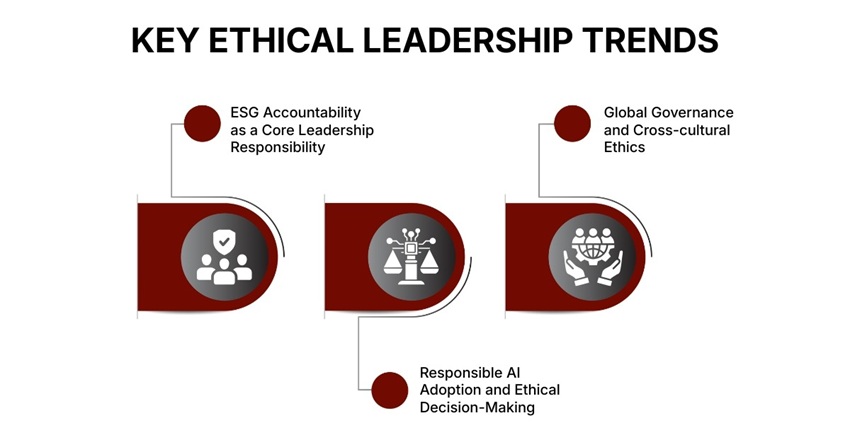
1. ESG Accountability as a Core Leadership Responsibility
Environmental, social, and governance commitments are moving from optional disclosures to genuine leadership responsibilities. Leaders are increasingly expected to make decisions that balance profitability with purpose, and those who cannot articulate or act on that balance face growing pressure from investors, employees, and regulators.
2. Responsible AI Adoption and Ethical Decision-Making
As AI tools become embedded in hiring, performance evaluation, customer service, and strategic planning, ethical leaders must ensure these systems are used transparently, audited for bias, and deployed in ways that protect rather than disadvantage the people they affect. This is an area where the gap between leadership intention and actual practice is often wide.
3. Global Governance and Cross-cultural Ethics
Organizations operating across multiple markets must navigate varying legal standards and cultural norms without abandoning core principles. Ethical leaders in this context need the ability to hold values constant while adapting how those values are communicated and applied.
Conclusion
Ethical leadership is not a role someone holds; it is a standard someone maintains, consistently, under pressure, and even when no one is watching. The organizations that get this right tend to earn genuine trust from their employees, build reputations that withstand scrutiny, and attract people who want to do their best work in an environment that treats them well. The ones that get it wrong face the predictable consequences: high attrition, damaged credibility, and a culture where problems are hidden rather than solved.
Building ethical leadership at scale requires more than good intentions. It requires clear policies, consistent training, access to mentorship, and senior leadership that models the standard it expects from others. When those elements are in place, ethical behavior stops being an individual virtue and becomes an organizational one.
For professionals and organizations committed to building stronger strategic judgment, accountability, and values-driven leadership, structured learning can play a critical role. Programs such as Associate Business Strategy Professional (ABSP™) for emerging leaders, Senior Business Strategy Professional (SBSP™) for experienced decision-makers, and corporate partnerships offered by The Strategy Institute help translate leadership principles into practical strategic capability.
Frequently Asked Questions
Q. What is ethical leadership?
A. Ethical leadership is the practice of making decisions grounded in moral principles such as integrity, fairness, transparency, and accountability. It means leading by example and creating an environment where ethical behavior is expected and supported at every level of an organization.
Q. Why is ethics important in leadership?
A. Ethics in leadership builds trust, improves employee retention, protects organizational reputation, and ensures that decisions consider both business outcomes and their human impact. Without ethical leadership, organizations tend toward cultures where misconduct is tolerated and accountability is absent, outcomes that carry significant financial and reputational cost.
Q. How can leaders make ethical decisions?
A. Leaders make better ethical decisions by applying consistent principles: being transparent about reasoning, evaluating fairness across all affected parties, taking genuine accountability for outcomes, considering broader human impact, and assessing whether the decision holds up over time. Applying these considerations before acting, rather than after, is the practical foundation of values-driven leadership.
Q. How does ethical leadership apply to AI and technology decisions?
A. When organizations use AI tools for hiring, performance review, or customer decisions, ethical leadership means ensuring those systems are tested for bias before deployment, monitored after launch, and governed by people with the authority to intervene when problems emerge. The Amazon recruitment algorithm case is a direct reminder that automating a decision does not remove the ethical responsibility for it. Leaders remain accountable for what their systems do, even when a human is not making each individual choice.
Q. What is the difference between ethical leadership and compliance-based leadership?
A. Compliance-based leadership does what the rules require. Ethical leadership does what is right, which often means going beyond what is technically permitted or legally required. A compliance-focused manager might approve a decision because it does not violate policy. An ethical leader asks whether the decision is fair, whether it respects the people affected, and whether it reflects the values the organization genuinely holds. The distinction matters most in gray areas, where rules do not provide a clear answer and judgment is required.