Understanding External Business Environments with PEST and PESTLE Analysis
 June 21, 2024
Businesses operate in a continually changing environment surrounded by various external factors that directly or indirectly impact their operations and potential for success. To stay ahead of the competition and make informed decisions, companies need to assess how such macro-environmental determinants influence their industry and plan accordingly. This is where undertaking a thorough PEST or PESTLE analysis acts as a strategic framework for holistically examining political, economic, social, technological, legal, and environmental influences.
What is PEST Analysis?
Coined by Harvard professor Francis Aguilar in 1967, PEST analysis is a business strategy model used to evaluate these macro-environmental factors that may have a high impact on an organization. It is basically a scan of an organization's external macro-environment in which it operates that provides important information to identify opportunities and threats as they develop. By keeping track of the economic, social, cultural, demographic, environmental, political, legal, and technological changes in its remote or macro-environment, a firm can prepare for the structural changes that might happen in its industry or market.
PEST Analysis Explained
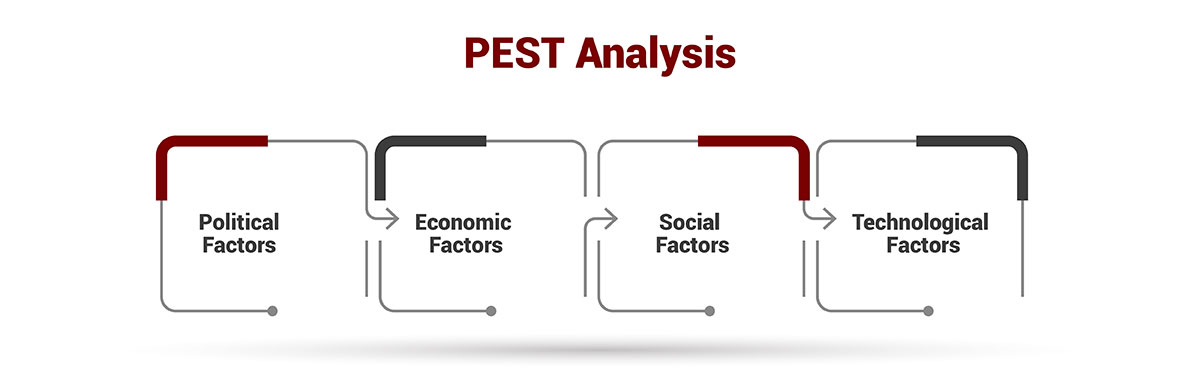
A PEST analysis involves closely looking at four key contexts that form an organization's broad macro-environment:
-
Political - This context evaluates how government policies, taxation, political stability, and trade regulations influence business operations and industry trends. Political instability or unfavorable policies can pose threats, while new opportunities may arise through structural changes.
-
Economic - The economic context focuses on external economic trends like economic growth rate, exchange rates, inflation, interest rates, and unemployment levels that indicate demand and shape consumer purchasing power. Economic recessions or booms significantly impact industries.
-
Social - This part examines shifts in demographics, social attitudes, educational trends, health consciousness, and mobility that affect market potential and customer behavior. Changes in social trends often lead to new market segments or product areas.
-
Technological - The technological factor considers the rate of technological innovations, spending on R&D, technology incentives, and digital disruption levels that influence work processes and industry competitiveness. Technology adoption provides both challenges and new prospects for growth.
Elements of a PEST analysis
A comprehensive PEST analysis involves breaking down each of the above contexts into specific elements and analyzing their projected influence individually.
For instance, to assess the "Political" aspect thoroughly, factors like - government policy changes, political stability or instability, trade restrictions, tax policies, and labor laws must be evaluated. Likewise, elements under "Economic" can include GDP growth rates, interest rates, inflation rates, currency exchange rates, and disposable income levels. Thoroughly covering constituent elements helps obtain a granular understanding of the macro-environment.
Understanding PEST Analysis with an Example
Let us understand PEST analysis with a hypothetical example:
A food manufacturing company based in India conducts a PEST analysis to understand the industry outlook and opportunities in other markets.
-
Political - Changes in import tariffs in key export nations, as well as unfavorable regulations on preservatives used.
-
Economic - Slowing GDP growth predicts lower demand. Falling currency value boosts exports.
-
Social - Rising health awareness increases demand for organic products.
-
Technological - Automation cuts production costs. Blockchain ensures supply chain transparency.
This analysis flags political and economic headwinds while indicating social and technology tailwinds to tap newer markets and products. The outcome guides strategic decisions and resource allocation.
PEST Analysis in Strategic Management
A PEST analysis forms a crucial initial step in strategic management and planning. Analyzing opportunities and threats in the macro-environment helps define an organization's strengths, weaknesses, and long-term objectives aligned to the industry trends identified. It acts as a situational analysis to determine strategic issues that demand attention or present new chances.
The outcomes of the analysis feed into the development of corporate, business, functional, and operational strategies to capitalize on and address external factors simultaneously. Periodic PEST reviews keep strategies up-to-date and future-ready as market conditions evolve.
Benefits of a PEST analysis
While carrying out environmental scanning through PEST analysis, businesses can reap notable benefits:
- It helps gain a bird's eye view of diverse macro-level influences in a consolidated manner.
- The analysis clarifies less visible remote factors and brings more uncertainty into strategic focus.
- It brings awareness of changes early so that people can act proactively rather than reactively later.
- The informed strategic decision-making it supports leads to more chances of success amid complexity. By recognizing opportunities in evolving contexts, companies can craft strategies for growth.
- It boosts long-term preparedness by accounting for uncertain macroeconomic determinants upfront.
- Regular PEST reviews enhance strategic agility to respond swiftly if any assumptions get invalidated.
- The structured methodology systematically incorporates external analysis into internal planning.
PEST Analysis Disadvantages and Limitations
However, PEST analysis also has some limitations that require consideration:
- The dynamic nature of environments means that the analysis may be outdated soon and will require frequent updates.
- It involves guesswork and assumptions about uncontrollable remote variables and their implications.
- The broad scope deals with huge amounts of external data, necessitating rigorous analysis.
- Insights rely on secondary research, which introduces risks of inaccuracy from external sources.
- The analysis alone does not suggest a clear course of action but only identifies broad factors.
How to Conduct a PEST Analysis
Here are the basic steps to conduct an effective PEST analysis:
-
To successfully carry out a PEST analysis, one must start by clearly laying out the objectives and boundaries of the analysis. It is important to pinpoint the precise industry, sector, or market that the analysis will zoom in on. This provides focus and direction for the entire process.
-
Once the scope is established, a cross-functional team should be brought together. Experts from different divisions like marketing, production, finance, and research must be roped in. Having varied perspectives will allow for a well-rounded analysis that examines external impacts from multiple angles.
-
With the team in place, the analytical work can commence. The first job is to systematically identify the political, economic, social, and technological macro-environmental factors relevant to the predefined focus area. This involves deeply researching reliable sources to dig up both quantitative and qualitative data related to each PEST factor.
-
Paying close attention to nuanced details, the group must analyze how the various factors are likely to impact the organization going forward. They need to weigh each factor's influence and project to determine whether it will pose a threat, present an opportunity, or remain neutral. Understanding the direction and magnitude of effects is key.
-
Importance must then be assigned to the most impactful factors based on their effects as well as probability. Prioritizing the most pressing issues draws attention to the areas demanding immediate strategic consideration. The less consequential aspects can be kept in peripheral view for future planning.
-
Once the evaluation is complete, findings should be organized coherently in a structured written report. This report ought to bring the opportunities uncovered clearly to the fore while spelling out the threats looming on the horizon. Recounting the outcomes in an accessible format sets the stage for successful communication.
-
Continual updating is also fundamental to the PEST process. As external dynamics are constantly shifting, the analysis must be consistently reviewed and refreshed. Tracking changes over time ensures that strategic perspectives are not based on outdated assumptions. Periodic re-examinations help maintain an accurate understanding of impacts.
-
Effectual communication of the PEST results to organizational leaders is equally essential. By presenting outcomes and recommended actions in an engaging manner, decision-makers can be convinced to truly embed the insights into planning. Two-way dialogue about implications and next steps further catalyze impactful decision-making.
-
Ultimately, the end goal of a PEST analysis is to integrate learnings into the very fabric of corporate strategies, plans of action, budgets, innovative initiatives, and more. This final stage of conversion is what actually allows the organization to ride opportunities and navigate risks, positively influencing performance.
In summary, by systematically carrying out each step of political, economic, social, and technological scanning and translating outcomes, organizations can gain a robust understanding of their evolving environment to proactively guide competitive maneuvers. A diligently conducted PEST process remains a powerful management tool.
What is a PESTLE Analysis?
An expanded version, PESTLE or PESTEL analysis, includes two more environmental factors - Legal and Environmental. This helps examine crucial legislative and ecological influences as well.
Legal - It evaluates the impact of consumer protection laws, discrimination laws, antitrust regulations, employment laws, health & safety laws, import/export laws, etc.
Environmental - It looks at ecological and environmental aspects like weather changes, pollution controls, waste management norms, sustainable development goals, and carbon footprints on businesses.
PESTLE thus provides a more comprehensive external analysis by widening the strategic context assessment even further. The additional legal and ecological scanning augments strategy planning effectiveness.
Top Best Practices for PESTLE Analysis
To optimize the effectiveness of PESTEL or PEST analysis, a few best practices are recommended:
- Narrow down the scope based on core objectives and avoid being too broad.
- Assign clear roles and form diverse cross-departmental teams for richer insights.
- Seek both qualitative and quantitative data from in-house and external experts.
- Adopt a systematic approach with set timelines rather than an ad-hoc exercise.
- Continuously track results against original assumptions and refresh periodically.
- Integrate findings centrally into overarching business strategy formulation.
- Quantify impacts wherever possible rather than just listing factors subjectively.
- Effectively communicate insights to drive well-informed decision-making.
- Revisit and refine the process over time based on learnings from experiences.
- Leverage suitable software tools for advanced data collection, analysis, and reporting.
Bottom Line
With rapid changes characterizing external environments constantly, comprehending diverse contextual influences is critical to thrive as a business. Strategic analytical frameworks such as PESTEL and PEST analysis empower organizations to proactively capitalize on shifting macro-level determinants and secure a sustainable competitive edge.
When practiced judiciously along with other strategic management techniques, these strategic tools support crafting all-inclusive strategies in sync with current realities and future prospects. Periodic environmental scans keep the insights actionable to respond to uncertainties effectively over the long haul.